Category Archives: LEADERSHIP – ALWAYS!
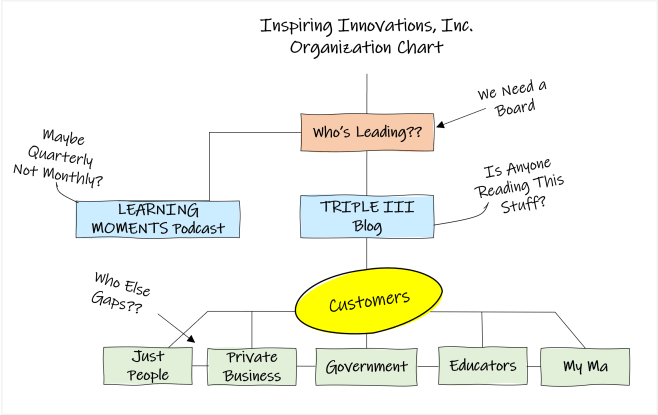
TRIPLE III TIME: Organization “Charting”
In the past year I have had the opportunity to view a number of organization charts from agencies large and small… and even a few private sector companies. Keep in mind that I was only able to look at them just for awareness purposes. However, my “always a better way” mind almost instantly took me into that “I wonder if they would let me innovate this” zone!
This week’s TRIPLE III TIME message will use my TOP 10 format to raise some innovation zone issues with regard to Organization “Charting”. Our times and purpose are so different today. Does YOUR chart reflect the change factor?
- Does your chart only change when employees change?
- When was the last time you audited your Organization Chart for accuracy?
- Are the positions still valid… the same?
- Are the chart’s service/product divisions appropriate for the times?
- Do the lines of supervision and reporting still make sense?
- Would the Board of Directors understand/support the structure the chart represents?
- Do the job titles correctly represent up-to-date employee responsibilities?
- Is your Organization Chart confusing, overwhelming, not enough or too much information?
- Can you easily see gaps in employee accountability?
- Does your Organization Chart feel like it needs to be a constant work in progress?
The goal of this TRIPLE III TIME message is to simply encourage everyone to review/assess their Organization Chart. Does it give a feel of “where you have been”…or an energy of “where you are going”?
Take a hard look!
TRIPLE III TIME: LEADERSHIP: We All Need Reminders
Leadership is and continues to be an ever-learning professional skill area. Even when you think you have “mastered the art” of understanding and implementing great leadership strategies, a new, different, 21st century challenge arises.
Recently a great friend and colleague passed along highlights from a leadership training series her group sponsored. The workshops were presented by Lou Rabaut and here are several self-improvement reminders he shared:
- An emotional (psychic) paycheck is important to an employee’s job satisfaction.
- It isn’t always what is said, but how it is said that influences your team.
- Emotional intelligence is something that can be learned and developed, and will add value to anyone’s leadership and other relationships.
- People who are more emotionally intelligent tend to be more self-aware, self-confident, empathic, curious, passionate, optimistic, adaptable, grateful and balanced. They also tend to be deeper thinkers, change agents, and can discern wants from needs.
- You cannot influence people unless they trust you; trust happens when a person is competent, acts with character and connects with others.
- When engaged in conflict resolution with your team members: define the conflict as us versus the problem, identify shared values/beliefs/concerns, separate opinions from facts, and actively listen.
- Consider using an O3 (one-on-one) meeting with your team members: a regularly scheduled meeting between the employee and the leader, is managed by the employee, sticks to an agenda, keeps alignment/focus, and helps prevent emergencies.
- Remember that not everyone learns the same way you do.
- An effective on-boarding process for a new hire leads to greater probability of retention.
Thanks Jackie for helping all of the TRIPLE III TIME readers benefit from one of the leadership opportunities you arranged for your organization.
TRIPLE III TIME: Slowing The Rush To Help
Growing up in a caring family and eventually spending my entire career centered in assisting people/businesses/organizations to “be better”…has caused me to realize that recent times have pushed everyone to try and help even more quickly/completely than ever before.
Think about it.
Our governments are sending millions of dollars to all areas of our economy to help and improve our country. Technology experts are designing and sharing faster, more efficient computer programs every day. Local schools and colleges are blending and modifying learning/training opportunities that quicken the process of education progress.
So how are we doing?
This week’s TRIPLE III TIME message is a simple answer and recommendation that we all try Slowing The Rush To Help responsibility. What do I mean in everyday practical terms? I mean we need to give the same amount of time to LISTEN to those needing help…as we do prescribing a help solution. Next as we consider an opportunity to help we need to offer assistance based on the TRUE NEEDS of a customer and not help in a way that “fits” our own professional convenience. Finally by Slowing The Rush To Help we may realize that more money or specialty services may not be the best help option. Instead applying PATIENCE, maximizing non-routine OPPORTUNITIES, recruiting additional RESOURCE PARTNERS, and CUSTOMIZING helpful action steps may prove more beneficial.
If we begin Slowing The Rush To Help…time and timing will be on our side.

TRIPLE III TIME: GIVING (Not Paying) FORWARD

As I draft this final TRIPLE III TIME message for 2021, I can hardly believe that we have been sharing thoughts and ideas about communication, leadership, innovation and professional development for eight years. Sometimes the messages come naturally, sometimes with challenges…but always with the hope that each helps every reader in a special personal or professional way.
This last 2021 TRIPLE III TIME message GIVING (Not Paying) FORWARD was created by the post-retirement activities undertaken by a very great friend. First, I am assuming that everyone understands what is meant when you talk about the person “Paying Forward” for a product or service for a total stranger. Maybe it’s paying for a cup of coffee, restaurant tab and/or the fare to go across the Mackinaw Bridge! These good deeds are referred to as special “Paying Forward” acts of kindness…and it is hoped that they are replicated by the recipient. But today I want to alter our “Paying Forward” act perception and substitute the unique value of GIVING (Not Paying) FORWARD.
My friend who was/is a very successful business person who decided to initiate GIVING FORWARD activities for several young adults he had just happened to connect with. What GIVING FORWARD help does he offer you ask? Well his great GIVING FORWARD advice/coaching includes educational recommendations, career mentoring, relationship development, parenthood issues, business profit & loss challenges and sometimes just fatherhood-isms. His GIVING FOWARD times never seem to have an agenda but are always given focus by the life experiences concerning each of his GIVING FORWARD “adoptees”. Money and personal finances may be a topic…but never an expected benefit action.
Bottomline: The goal of this TRIPLE III TIME message is to encourage everyone to consider a GIVING FORWARD action with someone. It’s a great learning example to end our year with…and an example to think about starting in 2022.
TRIPLE III TIME: The Importance of KEY WORDS!
This week we are going to talk about “The Importance of KEY WORDS!” that describe you, that you use as a means of making a priority point, or that possibly drive you to take professional action on a particular issue. I believe everyone establishes a unique form of communication through the use of KEY WORDS while on the job.
 What do I mean? Well let me provide two personal examples. First anyone who has ever worked with me knows very well what I mean when I USE the word “cause”. They understand that I am referring to the mission of helping people, helping businesses and/or the community to be better. Likewise, when I HEAR the phrase: “We have never done or tried to do this before”…colleagues know my innovation instincts kick into high gear and drive me to take on a new professional challenge!
The goal of this week’s TRIPLE III TIME message is to encourage everyone to pay professional attention to The Importance of KEY WORDS! that describe/define YOU! Think about the KEY WORDS that communicate who you are…what you stand for…that people use to describe you…and label you in your world-of-work. Are they positive and progressive or passive and uncertain? I even ask candidates that I interview for jobs or project assignments: Give me three KEY WORDS that define/describe you.
Give some quality time to understanding The Importance of KEY WORDS! in communicating your status as a person and worker. Let me know your results.
TRIPLE III TIME: 5-M’s of Implementation Essentials
One of the most critical responsibilities in running a business, organization, school and/or governmental entity is going through the process of implementing a new program, project or service. Helpfully in most cases there are pre-determined administrative planning guidelines and tasks to complete that will hopefully move you toward successful implementation. But what about assembling the right people? Who should be at the implementation table to ensure the strongest new initiative is prepped and ready?
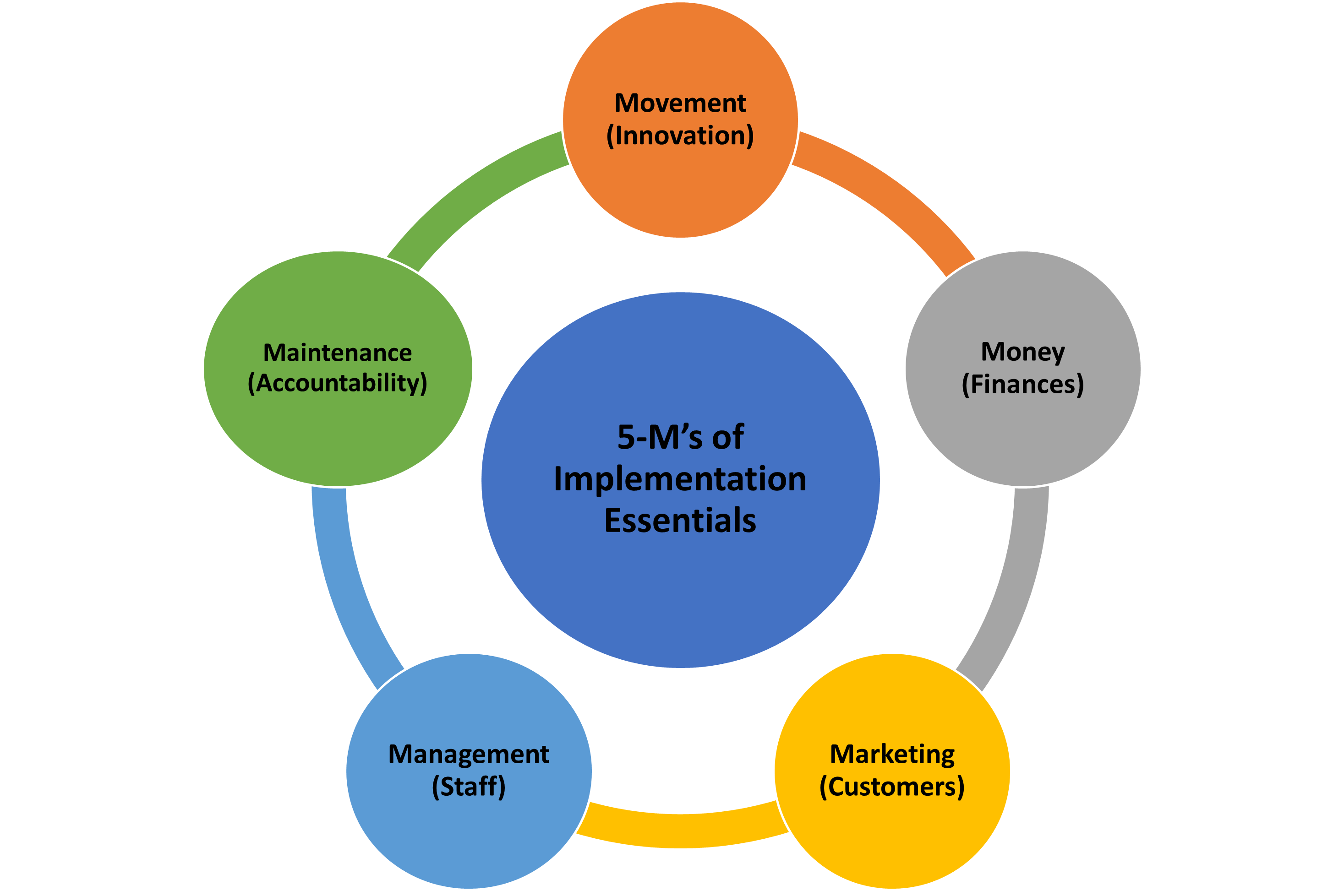
This week’s TRIPLE III TIME message is dedicated to describing the 5-M’s of Implementation Essentials with regard to personnel necessary for GREAT new initiative start-up and operation. The 5-M’s stand for: Movement (Innovation)-Money (Finances)-Marketing (Customers)-Management (Staff)-Maintenance (Accountability). I believe it is vital to have strong leaders from within your group that specialized in each of these areas to help design and facilitate the best implementation plan possible!
During my career I was very lucky to have representatives from the 5-M’s of Implementation Essentials involved and committed to “across the board” effectiveness, efficiency, unity and performance everyday…EVERYDAY. Did we always agree on everything…NO! But the ever present drive to find and deliver a product that was better than anything currently available…was always a solid motivator.
Bottomline: When it is time to build the right implementation plan and process for ANY new endeavor, be sure to gather dedicated personnel from the areas of Movement (Innovation)-Money (Finances)-Marketing (Customers)-Management (Staff)-Maintenance (Accountability)…and I know you will be very pleased with the future you build together.
TRIPLE III TIME: “Subtle Leadership”
 This year my Dad would have been 91. And I will openly admit that there are many times each week that I think about what he might say or believe about “the state of everything”. I contend that his comments would be brief and to the point…but in the most unique way…each statement would qualify as: “Subtle Leadership”.
So in my fun TRIPLE III TIME way…here are my DAD’s TOP 10 “Subtle Leadership” 2021 reflections:
- Mask or no mask…there’s work to do so get out there and do it.
- Only take stuff with you that you know you will need…the rest will get too heavy to carry.
- Make a note about what you need to get done…otherwise you will forget.
- If you say you already know everything…why am I telling you something you need to know.
- People get scared sometimes…and that’s ok.
- Do you listen or sing a few of the songs we used to play…and then smile.
- If people tell you they have not tried farming a certain way before…try it and be the first.
- Make time for feeding young and older calves and cows…you need them all.
- It’s OK to go out and work a field later at night…it gives you special time to think.
- Remembering only negative stuff can take up a lot of space in your brain.
Yes I can almost hear him say each of these TOP 10 “Subtle Leadership” points. Read them a couple times and think about how they may help you too.
TRIPLE III TIME: Leadership & Understandability
Many times those in leadership positions make statements or write notes and assume everyone hearing or reading them “gets” exactly what is being requested or explained. Assuming people can “read a leader’s mind” is often an operational weakness that if not addressed can have a huge spread of inaccurate information and directives throughout a business or organization. This challenge of achieving solid UNDERSTANDABILITY is even more pronounced if a leader has that “innovation-spirit” blended into their mode of operation. So how do we achieve a communication balance with regard to Leadership & Understandability?
I believe the majority of the responsibility in addressing this issue falls with leadership. First they must establish a culture of innovation understandability within the overall group. This means ENHANCED COMMUNICATION…openness for asking questions and freedoms for anyone to question the viability of proposed actions. Next in an effort to combat the inability for people to read the leader’s mind phenomenon, additional detailed WRITTEN-DOWN IDEAS must be a standard leadership practice.
Finally effective leaders must retain a high level of PERSONAL ACCESSIBILITY. This means that those in charge need to employ a schedule which allows co-workers and colleagues adequate time to share and converse. There is no way to totally measure the value of ensuring regular accessibility as a leader. However, operating in an always distant manner will undoubtedly create production and quality voids.
Leadership & Understandability are inevitably linked as important personnel management skill sets. Emphasize understandability. This action will enhance your leadership experience on all levels.
TRIPLE III TIME: Inaction As A Strategy
 Think about leaders you have worked for, collaborated with, admired, disliked or just plainly didn’t understand. More specifically consider the different strategies they used to make important decisions, create partnerships, turn down an opportunity or motivate employees to move forward to a greater service level. Can you recall any leader using Inaction As A Strategy?
Inaction As A Strategy is a very simple course of action. If there is a problem, conflict issue or progressive decision that needs to be made…and the leader is not ready to address it, inaction is often an accepted strategy. But is Inaction As A Strategy a good one? How about if we toss out a TOP 10 list of evaluation questions that measure it?
- Is choosing to do nothing sending a progressive message?
- As a leader will people understand your position if inaction is your plan?
- Are you automatically falling behind as an organization if you stand still and be inactive?
- What about customers…do they benefit from inaction?
- If the New York Times was doing an article on your use of Inaction As A Strategy would the article be a positive one?
- If now is not a good action time…what would make a later time better?
- Can you give examples of using Inaction As A Strategy that were beneficial?
- If your Board used Inaction As A Strategy for any issue…would you be happy?
- Do all the changes in technology make Inaction As A Strategy more or less appropriate?
- Finally, would the leaders you admire most be proud or sad if you used an inactive strategy on a critical issue?
Yes…yes I can hear all the voices reminding me that no two issues are the same and maybe waiting to make a decision/take an action would be most appropriate.
Regardless, my TRIPLE III TIME advice: Re-read the TOP 10!
TRIPLE III TIME: Job Descriptions: Setting Limits or Setting Priorities?
This week we are “analyzing” job descriptions. Have you looked at yours…or anyone’s job description lately? When you read through it…do you feel it provides you with work limitations…or does it serve as a guide for setting priorities for solidly performing your day job? Finally does a review of your job description leave you with a feeling of empowerment…or an ability to proclaim in so many areas: “Hey that’s NOT my job!”?
Too many times in too many workplace situations the wording contained in a job description drives down creativity and innovation. Think about it. Do people really look at their job description to measure WHAT ELSE they could be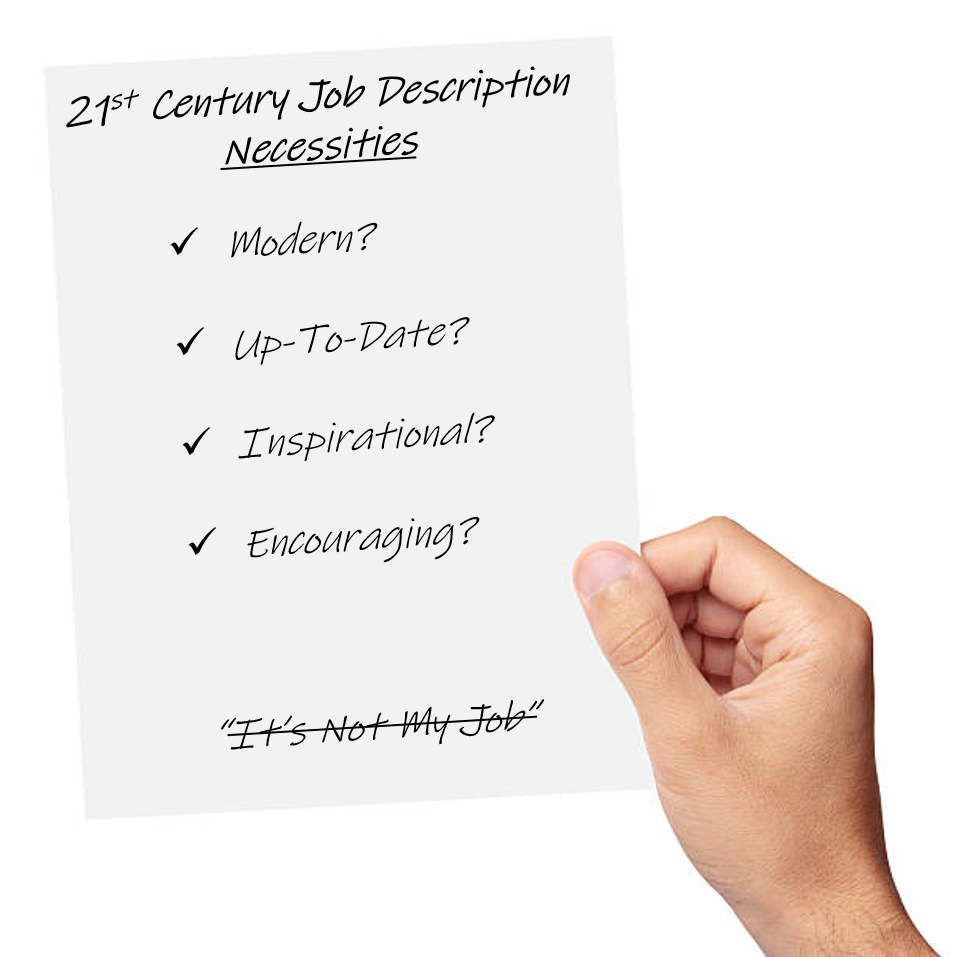 doing…or determining the limits of what they have to do? And even when you see that little sentence that says: “All other duties as assigned by leadership…isn’t it sad to believe that you have to be told to do a little extra?!
This weeks TRIPLE III TIME message: Job Descriptions: Setting Limits or Setting Priorities is intended to impact both employers and employees. First don’t use job descriptions as “its not my job” hiding places. There truly isn’t a more continuing improvement defeating phrase. Second, leadership should not construct job descriptions that contain words which lead to employment limiting interpretations. Instead use terms that encourage assuming additional assignments and suggesting professional improvement.
I understand job descriptions have a valuable purpose. My questions is: Do your job descriptions limit employee potential or provide priority guidance for growth and opportunity?

