TRIPLE III TIME: Sharing “Multi-Skill” Qualifications
Worker shortages are a major contributing factor to the supply chain product and service voids felt all around the world. “HIRING NOW” signs can be seen posted everywhere in business windows large and small. Those working in the labor exchange systems have been additionally pressed from both the employer and potential employee standpoint to help make the perfect business-personnel selection decision.
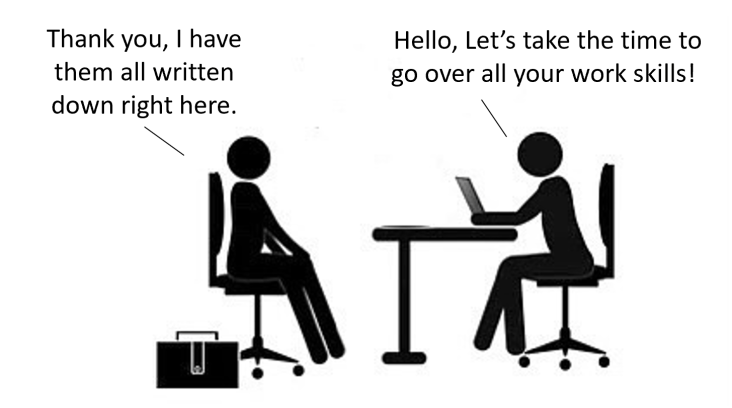
As I have witnessed this scenario unfold, an interesting “weakness” in the worker recruitment process has arisen. With the additional usage of technology in the recruitment, screening and worker selection system, the incidence of Sharing “Multi-Skill” Qualifications has strategically declined.
What do I mean?
I believe that due to the fact that many companies and organizations have now gone to an online application process, the opportunity for candidates to offer a more in-depth description of their total skills has been reduced. Individuals often have skills that may not directly apply to the job they are seeking…however they may be ideal for another project that is “in the hopper!” And with interview and screening time always at a premium, the likelihood of having a segment for Sharing “Multi-Skill” Qualifications is highly unlikely.
It is my TRIPLE III TIME recommendation that improvement for Sharing “Multi-Skill” Qualifications lies equally on both sides of the desk. Job applicants must make it a written and verbal priority to strategically share their direct and indirect employment skills. Business/organization leaders must also structure their employee recruitment systems to capture the maximum professional skills information they can on every candidate.
An additional 30 minutes in both areas could prove invaluable for everyone’s future!
TRIPLE III TIME: The Importance of Presence
 It is often ironic, interesting and maybe even scary when my choice for a TRIPLE III TIME message somehow connects directly to one of my current day business or personal situations. However, when you consider topics regarding leadership, communication, professional development and innovation…which are my III discussion priorities…the “connections” make sense! But I have to report that when I selected The Importance of Presence for this week’s message, it’s “connect-ability” factor to all aspects of my professional career…past, present and future…could not be more critical.
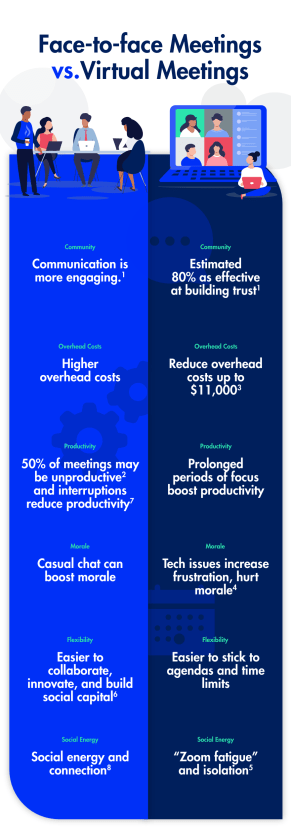
So let’s start this discussion by stressing the importance of physically attending meetings that you are part of. Personally showing up at a special event/meeting hosted by a colleague, family member, business partner or friend just feels more necessary today more than ever before. Likewise if you reverse the situation and ask what does The Importance of Presence mean to me as a professional when I am waiting at the door for those invited to attend? I believe it means caring, interest, support, joint venture consideration, a future opportunity and without a doubt…a special form of respect and friendship.
Does this mean that I do not support virtual involvements? Does this mean that I am too old-fashioned? Or does this mean that I have not allowed myself to adjust to a non-face-to-face future?
Well, I think all who know me have a pretty good idea how I may or may not answer these questions.
Regardless, the goal of the TRIPLE III TIME message: The Importance of Presence is to encourage everyone to go the extra face-to-face participation mile if you can. Virtual attendance is an acceptable second choice but I believe your personal/in-person connection can and will always make a good…GREAT difference!
TRIPLE III TIME: Recognizing/Identifying Gaps & Weaknesses
This week’s TRIPLE III TIME message is about the importance of periodically going through an evaluation process of Recognizing/Identifying Gaps & Weaknesses in you as a professional and/or the organization/business you work for. Isn’t this possibly the greatest example of “professional discomfort” you can think of!?
So then I want everyone to think hard about this professional discomfort generating activity…and honestly determine if you can really complete this type of an evaluation thoroughly.
I can report that I go through this type of process at least once a week. And during my self-assessment steps I think about:
- Did I cover all topics that seemed necessary in the American Government & Politics classes I teach?
- Were there gaps in my instruction or weaknesses in my delivery because I wasn’t prepared?
- Did I interact or follow-up with every consultant customer on their expectations of me…and my assignments to them?
- Did I reveal gaps or weaknesses in their organizational structure, product line, communication methods, etc.?
As you can see there are multiple approaches and useful results that may come out when Recognizing/Identifying Gaps & Weaknesses. Often you may find trends, situations that can lead to creativity and innovative alternatives. And if you extend your assessments to include your team of co-workers, Agency or company, who knows what progress concepts could be suggested.
Finally the Recognizing/Identifying Gaps & Weaknesses activity may help you realize that you may be too close to an issue to see it clearly and/or discover that the problems may not at all be what you thought.
Bottomline: Do NOT just conduct the Recognizing/Identifying Gaps & Weaknesses activity on a random basis. It’s value arises from assessment consistency.

TRIPLE III TIME: Organization “Charting”
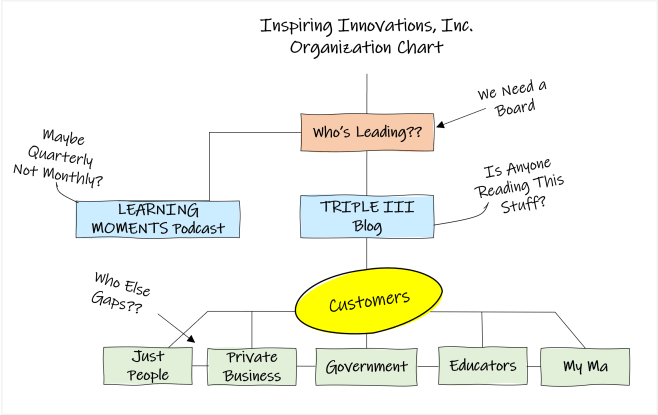
In the past year I have had the opportunity to view a number of organization charts from agencies large and small… and even a few private sector companies. Keep in mind that I was only able to look at them just for awareness purposes. However, my “always a better way” mind almost instantly took me into that “I wonder if they would let me innovate this” zone!
This week’s TRIPLE III TIME message will use my TOP 10 format to raise some innovation zone issues with regard to Organization “Charting”. Our times and purpose are so different today. Does YOUR chart reflect the change factor?
- Does your chart only change when employees change?
- When was the last time you audited your Organization Chart for accuracy?
- Are the positions still valid… the same?
- Are the chart’s service/product divisions appropriate for the times?
- Do the lines of supervision and reporting still make sense?
- Would the Board of Directors understand/support the structure the chart represents?
- Do the job titles correctly represent up-to-date employee responsibilities?
- Is your Organization Chart confusing, overwhelming, not enough or too much information?
- Can you easily see gaps in employee accountability?
- Does your Organization Chart feel like it needs to be a constant work in progress?
The goal of this TRIPLE III TIME message is to simply encourage everyone to review/assess their Organization Chart. Does it give a feel of “where you have been”…or an energy of “where you are going”?
Take a hard look!
LEARNING MOMENTS Podcast: “Are You A Student Of Your Business… Your Job?”
Sometimes in my LEARNING MOMENTS podcasts or my TRIPLE III TIME blog messages I promote the need to “take your job personally.” And by doing so I am hoping you make your employment experiences all that they can be and possibly more.
This month’s Inspiring Innovations LEARNING MOMENTS podcast topic “Are You A Student Of Your Business… Your Job?” … is all about heightening your PERSONAL interest and commitment to being professionally successful. During the podcast I offer a series of self-evaluation questions that should help enhance your “Student” efforts and perhaps become The Greatest Of All Time!
Enjoy the message.
TRIPLE III TIME: LEADERSHIP: We All Need Reminders
Leadership is and continues to be an ever-learning professional skill area. Even when you think you have “mastered the art” of understanding and implementing great leadership strategies, a new, different, 21st century challenge arises.
Recently a great friend and colleague passed along highlights from a leadership training series her group sponsored. The workshops were presented by Lou Rabaut and here are several self-improvement reminders he shared:
- An emotional (psychic) paycheck is important to an employee’s job satisfaction.
- It isn’t always what is said, but how it is said that influences your team.
- Emotional intelligence is something that can be learned and developed, and will add value to anyone’s leadership and other relationships.
- People who are more emotionally intelligent tend to be more self-aware, self-confident, empathic, curious, passionate, optimistic, adaptable, grateful and balanced. They also tend to be deeper thinkers, change agents, and can discern wants from needs.
- You cannot influence people unless they trust you; trust happens when a person is competent, acts with character and connects with others.
- When engaged in conflict resolution with your team members: define the conflict as us versus the problem, identify shared values/beliefs/concerns, separate opinions from facts, and actively listen.
- Consider using an O3 (one-on-one) meeting with your team members: a regularly scheduled meeting between the employee and the leader, is managed by the employee, sticks to an agenda, keeps alignment/focus, and helps prevent emergencies.
- Remember that not everyone learns the same way you do.
- An effective on-boarding process for a new hire leads to greater probability of retention.
Thanks Jackie for helping all of the TRIPLE III TIME readers benefit from one of the leadership opportunities you arranged for your organization.
TRIPLE III TIME: Slowing The Rush To Help
Growing up in a caring family and eventually spending my entire career centered in assisting people/businesses/organizations to “be better”…has caused me to realize that recent times have pushed everyone to try and help even more quickly/completely than ever before.
Think about it.
Our governments are sending millions of dollars to all areas of our economy to help and improve our country. Technology experts are designing and sharing faster, more efficient computer programs every day. Local schools and colleges are blending and modifying learning/training opportunities that quicken the process of education progress.
So how are we doing?
This week’s TRIPLE III TIME message is a simple answer and recommendation that we all try Slowing The Rush To Help responsibility. What do I mean in everyday practical terms? I mean we need to give the same amount of time to LISTEN to those needing help…as we do prescribing a help solution. Next as we consider an opportunity to help we need to offer assistance based on the TRUE NEEDS of a customer and not help in a way that “fits” our own professional convenience. Finally by Slowing The Rush To Help we may realize that more money or specialty services may not be the best help option. Instead applying PATIENCE, maximizing non-routine OPPORTUNITIES, recruiting additional RESOURCE PARTNERS, and CUSTOMIZING helpful action steps may prove more beneficial.
If we begin Slowing The Rush To Help…time and timing will be on our side.

Public Administration In Rural America
Sometimes it is so important as a concerned U.S. citizen and career-long public servant to stop and evaluate the governmental decision-making processes in your own backyard. In my world of work Public Administration In Rural America has and continues to be an ongoing area of progressive concern.
This week’s TRIPLE III TIME message is my quarterly American Society of Public Administration article. In it I “gingerly” address the topic of aging rural elected officials and the limited decision-making credentials they often retain. As always I briefly offer a couple innovative system improvement ideas regarding these challenges. However as you read the article…think about small city, township, county and special purpose governmental units and their board make-ups. Concerns?
TRIPLE III TIME: Finding the “I Can Help Sweet Spot”
I am not sure why…but more recently the everyday consultant challenge of Finding The “I Can Help Sweet Spot” for individuals and groups has become way more difficult. I know…everyone who knows me…knows I always have ideas. Whether the issue is dealing with performance, developing new service delivery concepts, customer recruitment, staff training…whatever I have ideas. However sometimes even the best ideas don’t seem to be the right ones.
 But then as I thought more about Finding The “I Can Help Sweet Spot” situation, I began to realize that this is NOT just a consultant challenge…it is an everyone who works with people challenge!
Today more than ever before it is critical to consider the “place” someone or an organization is before drafting and recommending alternative ways forward for them. The problems and issues people/groups face today are not traditional or historic. They are different and unique.
Next there is the question of “best fit”. Based on YOUR experiences and knowledge YOU are confident that YOU can identify the best “I Can Help Sweet Spot.” WRONG! The most important consideration is THEIR experiences and knowledge and then how together find a best fit option to move them forward.
Finally, people who work with people need to be prepared to recognize that the Sweet Spot may move forward, backward or even side-to-side during the I Can Help process…and this is something no one can control. It is just important to realize and accommodate.
So please keep these realizations in mind when Finding The “I Can Help Sweet Spot”! in your work/life. Don’t think you are failing when your initial ideas and recommendations aren’t a winner. Your authenticity and caring will be your most valuable asset.
LEARNING MOMENTS: Getting & Giving Professional Coaching
I think we have all thought about having someone you trust, admire, appreciate provide you with some professional coaching when dealing with a personal or work-related challenge. Today society would probably label that as having a “Life Coach.”
But this month our Inspiring Innovations LEARNING MOMENTS podcast takes an inclusive view of this advising responsibly by discussing both Getting & Giving Professional Coaching. Specifically, the LEARNING MOMENTS shared calls on everyone to realize that Coaching is infused into everyone’s personal and professional lives. As a result, whether top-down / side-to-side / or bottom-up Coaching is high value. Even to the point of making it a part of your organizational personnel policies.
Enjoy the listen.
 Inspiring Innovations, Inc.