TRIPLE III TIME: Marketing Advice…Who ME?
 As a consultant you often get asked for advice or ideas on issues or projects that are not really in your area of expertise… yes marketing! But if you think about it…if the name of your company is: **INSPIRING INNOVATIONS, Inc.** it does make sense that potential customers may ask you about new, cool “innovative”, “inspiring” marketing ideas!
Well, don’t ever think that I would not take on a new challenge. And just to at least deliver this special message in my “comfort zone” style; here is a TOP 10 list of marketing thoughts to consider:
- Stay simple! Big words and long sentences don’t capture attention.
- Focus on one (1) service or product. Promoting a group of things at the same time often creates confusion.
- If possible cool colors adds “attention-drawing” value.
- Target market. Go to where your potential customers hang out…online or in-person.
- Experiment using different marketing options. Don’t assume what will or won’t work.
- Test market your initiative with those you trust. Make sure you ask and get honesty.
- Don’t be lured into being a marketing “copy-cat”. Originality matters.
- If your contact info is included…offer more than one option if possible.
- Product/Service exclusivity is an important marketing message.
- Finally however possible be consistent and regular. Sometimes marketing initiatives need to “age” to be noticed and effective.
You now have my first TRIPLE III TIME Marketing Advice message. I hope one or more ideas help.
TRIPLE III TIME: Recognizing & Appreciating “Security Blankets”
Did anyone ever GOOGLE the term “Security Blanket”? If you did, my guess is that you found Dictionary.com’s definition and meaning to read something like this:
“Someone or something that gives a person a sense of protection or a feeling of security.”
Now at first glance, you may be wondering which TRIPLE III TIME topic area does Security Blanket fall under? Communication? Professional Development? Innovation? Leadership? Or maybe that Special Topics area!
Let me explain.
Throughout my professional career, I have been fortunate to have co-workers that have provided me with that “sense of protection or a feeling of security.” Whether it was during a major Board meeting, preparing for an audit/monitoring visit, or delivering a workshop message, having individuals in the room that know, trust and support me has made me a better leader, communicator, and innovator!!
Likewise, I know I have reversed the Security Blanket role when I have attended a colleague/co-workers event/meeting. I could feel the extra confidence they had knowing I was there to support them and benefit from the learning they were offering. However, most often Security Blanket benefits are received in an unspoken and unthanked style…and are only quietly acknowledged.
This week’s TRIPLE III TIME message title: Recognizing & Appreciating “Security Blankets,” says it all. I recommend we break the Security Blanket silence and toss out a “THANK YOU” whenever you realize or experience a Security Blanket moment. Today I wish I could go back and let individuals or the gang know how protected and secure they made me feel everyday…EVERYDAY!
But I guess this TRIPLE III will have to fill the void for today.
TRIPLE III TIME: Advancing Branches of an “ACCOUNTABILITY TREE”
“There probably isn’t a more significant or more critical challenge for any leader at any level than supporting accountability and fairness. In the final analysis there will always be people who reject accountability if it doesn’t immediately support their cause or situation. And sometimes doing the right thing can come at a high price. Nonetheless, it is evident that most people thrive in an environment in which accountability and fairness define the organization’s culture.” (Dr. Lew Bender)
Selecting a meaningful quote from my mentor, colleague and long-time friend Dr. Lew Bender was not difficult when I considered ACCOUNTABILITY as this week’s specialized TRIPLE III TIME message focus. In his classes, workshops and written articles…Dr. Bender has always had a comfortable, common-sense manner of bringing forth critical issues and making them applicable in anyone’s world-of-work. He has followed that “trend” in his quote on ACCOUNTABILITY.
But wait…what does all of this great information about Dr. Bender’s instructional style have to do with this week’s TRIPLE III TIME message: Advancing Branches of an “ACCOUNTABILITY TREE”?
The answer is simple! First take another look at Dr. Bender’s quote and pull-out the separate terms that all connect with ACCOUNTABILITY.
- Critical Challenge
- Fairness
- Cause/Situation
- Doing Right Things
- Leader
- Support
- High Price
- Organizational Culture
Then picture an “ACCOUNTABILITY TREE” with all of these very important terms shown as “branches”. Can you see it? It truly represents a very progressive, impactful visual.
![Accountability Tree[10332]](https://inspiringinnovationsinc.blog/wp-content/uploads/2022/10/accountability-tree10332.png?w=604)
The Bottom-line III Message: I believe most organizations or businesses do not train their staffs well in the area of ACCOUNTABILITY. No matter the focus…individual…teams…or the entire entity, everyone should consider, reflect and contribute to Advancing Branches of an “ACCOUNTABILITY TREE”. Issues like clear expectations, honesty, directness, behavior, performance, roles, and communication all have a place on an Advancing Branch! And if these factors are progressively dealt with by ALL…the Branches WILL advance and grow. If not…will you know what will happen.
And as always…THANKS Dr. Bender for your help and support!
LEARNING MOMENTS: Understanding – Understandability
It is difficult to devise a way to slow down the speed and volume of information that is shared with us every minute of every day. The result is a growing lack of comprehension of the Who – What – When – Where and Why’s of actions and events going on all around us.
Hence we need to think about our capacity of: Understanding – Understandability!
This month’s Inspiring Innovations LEARNING MOMENTS podcast first discusses the reasons we are facing an Understanding – Understandability dilemma. And in the final minutes of the podcast, I try to offer a few recommendations to ease this dilemma.
I hope you enjoy the listen.
TRIPLE III TIME: “If You Have A Better Idea…?”
TRIPLE III TIME message ideas often show up because of situations I never saw coming! Just a few months ago I was asked to help conduct interviews with young adults to offer them insight and perspective about the interview process, questions often asked and the “behind the scenes” purpose of many topics that may be brought forth. It was a fun, interesting time…but the REAL new life experience for me came at the end of the session when five of my interviewees asked if they could now interview me?!
Of course, I say YES…and although the questions they asked were pretty basic, one stood out and has generated the topic for this week’s TRIPLE III TIME message.
“What was your main philosophy as an innovation leader?”
I know I had a very puzzled look on my face. Plus, as I searched my mind-history for a good answer, I couldn’t think of any MAIN philosophy that drove my innovation leadership style.
But then out of nowhere the absolute, true response to their question came out very naturally. I told the group that as I developed an innovative idea, project or program and naysayers regularly had all kinds of challenges to moving forward on the concept…my leadership philosophy was (and still is): “If you have a better idea…put it on the table. But if not we are going to get GOING!”
By my voice tone and strong delivery of this statement, the group understood my philosophy very clearly. There were no additional questions about the philosophy…rather lengthy discussions on the innovations I was privileged to be part of.
I recommend that all reading this TIRPLE III TIME message look inward and discover YOUR MAIN LEADERSHIP PHILOSOPHY! Think about what you stand for and what you consider a personal/professional growth philosophy. It is a wonderful, revealing action. Let me know what your philosophies are!
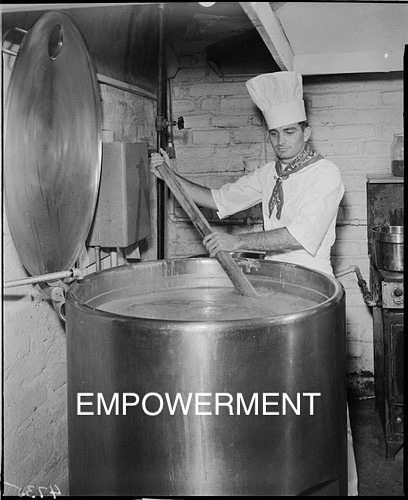
TRIPLE III TIME: The Recipe For EMPOWERMENT
One of the major action strategies I use everyday…EVERYDAY in my role(s) as a leader was/is to utilize co-worker EMPOWERMENT to maximize organizational performance and progress. What do I mean by EMPOWERMENT? Think about this simple definition:
“Empowerment-allowing people a choice of performance method and holding them responsible for the results.”
As an employee development tool, empowerment action makes a lot of sense and usually results in good outcomes. However, sometimes in my coaching/consulting moments, my client-customers ask a ton of good questions about “how do you make empowerment work”?
With those questions in mind, how about if we consider these TOP 10 TRIPLE III TIME ideas as The Recipe For EMPOWERMENT!
- Allow Empowerees (yes another new word) time to research work/performance improvement ingredients.
- Enable Empowerees to form new/unique co-worker alliances to improve products/services.
- Commit to the agreement that “perfection” is NOT the expectation…just improvements.
- Support failure in some areas as part of the creativity process.
- Do NOT add “we have always done it this way” comments as a component in your EMPOWERMENT recipe.
- Remember to permit Empowerees to change the recipe as the development process “bakes”.
- Plan for unexpected product/service expansion and/or diversity as EMPOWERMENT grows.
- Employ a new product/service “taste test” (i.e. evaluation system) to reinforce the “responsibility for results” promise.
- Be prepared for criticism and negativity from outside your organization.
- Utilize transparency with Empowerees and share outcomes (positives and negatives) with all involved.
EMPOWERMENT is progressively contagious. So, use The Recipe For EMPOWERMENT with positive optimism. I never regretted its use or potential!
TRIPLE III TIME: Are You Listening?
“We had received a few letters, and generally they were positive, but they would say: ‘It’s really too bad you use those foam peanuts. Have you thought of using something else?’ or ‘I am really going to have to start looking for another source if you guys don’t stop using them.’ People wanted to continue to order products from us, and they liked our service, but they objected to us using the foam peanuts. I figured if so many people had taken the time to write to us, then there must be many more people thinking along the same lines. So we stopped using foam and started using a tissue made from 100 percent recycled magazines instead.”
– Patricia Gallup, PC Connection, Inc.
The purpose of sharing this quote regarding customer feedback from a quality company is to ask you the question about your customers: Are You Listening?
Many times workers in companies and/or agencies who are responsible for collecting customer status or satisfaction information do not give this function the continuous improvement attention it deserves. Although it is true that customers are not always thoughtful and complete in their responses to quality survey requests, you can never assume you won’t find that “gold nugget” suggestion somewhere…sometime!
This week’s TRIPLE III TIME message: Are You Listening? is fully intended to force everyone to question themselves about their customer service follow-up process. Do you do it just because you must…or in search of a good idea? Do you really pay attention to the responses…or do you just check off who responded and how many? Or is your customer follow-up process outdated and just an assignment…and thereby self-defeating in its purpose?
Great companies/organizations put stock in getting quality feedback from their customers. Are you GREAT?
TRIPLE III TIME: IDEAS UNLIMITED CLUB
Innovation…Public Sector Innovation…IDEA GENERATION…and ENTREPRENEURSHIP in any form have been a vital part of my personal and professional life. No matter the organization and/or the challenge…my “There Is Always A Better Way” attitude, motivates me to go beyond what may be expected by those around me.
So what do you do to pass along this package of creative energy and drive in a meaningful, 21st century way?
You start a northern Michigan IDEAS UNLIMITED CLUB!
This week in partnership with Central Michigan University, Alpena Community College and 20+ high schools in northern Michigan, we held our first IDEAS UNLIMITED CLUB session.
Just to help everyone understand the IDEAS UNLIMITED CLUB is an Entrepreneurship-Driven “cooperative-partnership” focused on blending the business/community development learning efforts of Central Michigan University’s Isabella Bank Institute for Entrepreneurship, Alpena Community College and select Northeast Michigan School Districts. The principle function of the IDEAS UNLIMITED CLUB cooperative partnership is not just the sharing of basic Entrepreneurship concepts and processes, but also the employment of a unique monthly, structured Mentoring Moment facilitated by CMU students/affiliates engaged in Entrepreneurship coursework/projects that is shared with engaged community college and high school students.
How did we do: “Just Right!” The use of video-conferencing technology made the face-to-face “feel” a vital contribution. There was a lot of listening by all…but the importance of idea-sharing…for some maybe for the first time…was so COOL!
Yes I am passionate about the IDEAS UNLIMITED CLUB. And if it helps even one young adult across our multi-county Michigan region, we are all ENTREPRENEURSHIP WINNERS!

TRIPLE III TIME: VISIONARIES – Do You Know One?
When you hear the phrase: “He or she is a visionary,”…what comes to mind? That they can see the future? That they can predict the outcomes of certain events or actions? Or do you follow the Oxford Dictionary definition of a visionary which states:
“Visionaries are idealistic, imaginative and have inspired ideas about the future.”
Well as I selected: VISIONARIES-Do You Know One? as the topic for this week’s TRIPLE III TIME message, my focus was mostly on the Do You Know One part. And my guess is that as you think about do I know someone with vision, your mind goes to people like President Kennedy or Albert Einstein who as visionaries impacted our world. But today I want you to think about visionaries in a simple, small town manner. Think about:
- Farmers…don’t they have a vision every year about an excellent crop as they plant?
- Truck Drivers…don’t they dream about an on time (or ahead) of time safe delivery?
- Plumbers…don’t they have visions of quickly, efficiently fixing the leak in your house?
- Teachers…don’t they hope that all their students pass their classes with good grades?
- Doctors…don’t they all anticipate they can prescribe a cure for your illness…and it works?
- Employment Counselors…don’t they envision that everyone they help gets a GREAT job?
- Auto Mechanics…don’t they have a vision that they can fix your brakes…quickly?
- Construction Workers…don’t they dream of building a cool, unique house sometime?
- Musicians…don’t they envision playing a perfect song for an appreciative crowd?
- Authors…don’t’ they all foresee that they will write the next best seller?
So let me ask again, VISIONARIES-Do You Know One? Hopefully your answer is YES and by using the list of 10 Visionary examples…I hope you know you probably are one too!
he goal of this TRIPLE III TIME message is to encourage you to be a natural VISIONARY everyday…EVERYDAY! Never apologize for having a sense of idealism and imagination. Because that is what VISIONARIES are made of.

LEARNING MOMENTS: Seasons of Change
This month I chose a more serious topic for the Inspiring Innovations LEARNING MOMENTS podcast: Seasons of Change. Work families are a very important element in building and retaining a great workforce culture. And when someone leaves… for whatever reason… there are good and not-so-good ways of dealing with this transitional action.
There are no easy, standardized methods of working through Seasons of Change. The suggestions I offer are intended to be helpful, but every situation is different. Use LEADERSHIP – COMMUNICATIONS –PROFESSIONAL DEVELOPMENT – INNOVATION as your guiding principles, and whats best for everyone will be the result.
Enjoy the listen.
 Inspiring Innovations, Inc.