TRIPLE III TIME: “Remember When?”
Throughout the years that I have been writing these TRIPLE III TIME messages, I have reported that I never really am sure where motivation for a specific message may come from. However, this week my inspiration came about totally unexpectedly.
Since my wife’s recent retirement from the world of education, she has started going through boxes of “stuff” that has been untouched for years. The goal is to make us more organized. And as you can see she came across a very special picture that brought back a ton of memories…which made this III message timely.
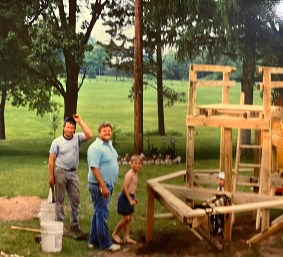 JHL and I have been friends, co-workers and colleagues for well over forty (40) years. There are a million stories I/we could share…but for this moment I believe a special TOP 10 of partnership would be best.
Let’s say it like this…Mr. JHL for me:
- Always offered a reliable, safe and confident listening ear yesterday, today and tomorrow.
- Provided a real meaning to the “I’ve got your back” statement.
- Made our service philosophy “For The Cause”… a daily reason to show up for work.
- Supported the building of an agency image which believed “There Is Always A Better Way” to help people.
- Served as the ideal “co-star” when showing off our innovations.
- Helped make personnel management always progressive.
- Facilitated an agency priority of partnerships…which proved to be the best way to do business.
- Conquered re-starting his job… to be even better than his first start.
- Never said “I don’t think we can” or “I don’t think I can help with that” regarding any brand new business or personal project I dreamed up..
- And lastly, he didn’t know that when he referred to himself as the “2nd Banana”…that I took that assessment to mean our Agency was better with two LEADERS!
Sometimes we all need to “Remember When” to make sure we appreciate friends, opportunities and future possibilities.
Thanks Chief!
TRIPLE III TIME: Realizing People’s “Building Blocks”
We have discussed it before…but working with people is the toughest job around. Trying to get people to work together effectively. Trying to understand why some choose to perform a task one way…while everyone else wants to do it another way. Or why some always show up late for work or don’t finish a certain assignment on time…any time!
 But did you ever take a little historical look and try to attempt Realizing People’s “Building Blocks”? What do I mean?
Think about what in their lifetimes may have led them to do what they do and why they are the way they are?!
- Did they finish high school…or did their parents?
- Do they have a “good” job…or ever had one that matched their talents and paid them well enough?
- Do they live in a good neighborhood…in a rural area…in a city?
- Are they religious?
- Were they a single child or did they come from/belong to a big family?
- Do they come from a broken family?
- Have they lived in a cultural-diverse area?
- Are they someone who grew-up following “the rules” completely…or is a risk-taker?
- Do they think they are too young or too old to “make-a-difference”?
- Does “what other people think” drive their decision-making…or are they a free-thinker?
This week’s TRIPLE III TIME message: Realizing People’s “Building Blocks” is all about making it a professional priority to better understand people before making quick judgments or generalizations. I believe as people work with others too often personal assumptions are made about someone which may be totally inaccurate. Will taking a little extra discussion time when making decisions about people in your workplace make you a better person…better LEADER!
Absolutely!
TRIPLE III TIME: Creating A QUALITY Communication Culture
Let’s start this TRIPLE III TIME message with a very simple question: Has your business or organization ever set aside a solid amount of time and resources with the single objective of: Creating A QUALITY Communication Culture? A culture of communication sessions brought together by everyone at all levels and with the goal that we will communicate better and more completely than anyone…anywhere?
Well have you?
Creating A QUALITY Communication Culture in your workplace/organization is not a one-time thing…it is a forever assignment. And before I find myself taking up valuable TRIPLE III TIME message space explaining why…let’s go quickly on to a TOP 10 Creating A QUALITY Communication Culture list of suggestions. Here goes:
- Anyone, anytime in an organization can initiate a QUALITY Communication Culture improvement concept.
- A QUALITY Communication Culture effort has no delivery limitations (i.e. oral/written/email/text/anything!)
- Using a “grapevine mentality” is a QUALITY Communication Culture prohibition.
- You do NOT need leadership’s approval to improve your Communication Culture.
- A QUALITY Communication Culture always requires you to re-review your message before you send it.
- Creating a QUALITY Communication Culture means YOU will take responsibility for what your message says.
- Remember that the skillful use of the three (3) T’s all play a role in Creating A QUALITY Communication Culture: Tone…Timing…Technology.
- Don’t Communicate just to speak…have a valid point.
- Perfection does not exist even in A QUALITY Communication Culture…so give people breaks.
- Finally, silence is allowable in A QUALITY Communication Culture…it can send a powerful message.
Creating A QUALITY Communication Culture is so vital in all workplaces and yes even at home. These special TOP 10 suggestions are probably just a starting spot to help grow your QUALITY Communication Culture…so get started!
TRIPLE III TIME: “I’ve Never Told Anyone About My Life-Long Idea!”
One of the most special career experiences I have had over the years was working with a small rural township community on “idea generation”! The project lasted several months and included city officials, township board members, local business people and representatives from the area school district…including students. My consulting service plan included several county-wide meetings, three IDEAS workshops, four in-school brain-storming sessions with students and finally an IDEAS booklet to inspire anyone and everyone to share and build on their community/business/education/entrepreneurship development concepts.
 There are several stories I could share but this TRIPLE III TIME message will focus exclusively on a discussion occurring at one of the last IDEAS workshops. There were about ten attendees including one older lady who always quietly sat in the back and took a lot of notes. And if you know me and my classroom discussion style…no one can “hide” and not participate in the sharing of ideas and how to be innovative everyday…EVERYDAY.
So when I walked over to her and simply asked: “Why have you attended all of these workshops?” She did not shrink away…rather she nervously stated because: “I’ve Never Told Anyone About My Life-Long Idea”.
Well as you can guess without much encouragement she told the whole group her entrepreneurial idea (which was GREAT) and the rest of the workshop was dedicated to helping her identify the best steps forward to possibly make her creative idea a reality.
The moral and TRIPLE III TIME message of this memory reflection is best explained in a quote by Harriet Minter author of GREAT TED TALKS: Leadership.
“Don’t be afraid to put what you know out there. The competitive advantage gained through collaboration is greater than when you operate in secrecy.”
And don’t wait 50+ years to tell someone about your idea(s). Holding too tightly to your IDEA to keep it totally yours may have the reverse effect on it and unintentionally “strangle it” from growing.
LEARNING MOMENTS Podcast: Making Use of the “Not Rights”
Learning valuable lessons from the “Not Right” decisions or actions taken by co-workers, supervisors, and/or leaders… is often not placed in a professional development context… but it should be!
This month’s Inspiring Innovations LEARNING MOMENTS podcast Making Use of the “Not Rights” is all about sifting through example-based learning that comes from assessing “Not Right” experiences. The practice is not always easy or comfortable… but necessary and proper.
Enjoy the listen.
TRIPLE III TIME: Customer Service Made Easy!
I don’t know if I ever stated (or admitted) this fact in any of my blogs or podcasts…but yes I played trumpet in my family’s polka band. And I have to say that although we were not the greatest polka band in the world…we were pretty good! My Dad played accordion…my oldest sister the clarinet…older brother the drums and me on the trumpet. The bottom line truth is that none of us were superb musicians (except my Dad)…but we were great entertainers.
 Recently I had the privilege of enjoying an old-time polka band playing in a small local venue. The music was wonderful and the band members although senior in their years…were very much crowd pleasers in every way. So now you are asking when and why did this TRIPLE III TIME Customer Service Made Easy message idea become prime time in my mind while basking in this great musical moment?!
Let me explain.
During our polka band time…we were a SOLID TEAM. Our COMBINED TALENTS and SKILLS created a helpful, meaningful product/service. Our PRESENTATION STYLE and DELIVERY was always authentic and consistent. And finally our ability to be FLEXIBLE and ADAPTABLE to the needs and wishes of all attending our events…resulted in Customer Service Made Easy!
It would be fun to share more about our polka band experience which all faded way too soon. But this week it was an extreme pleasure to describe how being a SOLID TEAM with COMBINED TALENTS and SKILLS…and a quality PRESENTATION STYLE and DELIVERY while remaining FLEXIBLE and ADAPTABLE can not only be fun…but also be a working example of Customer Service Made Easy!
TRIPLE III TIME: Customers as Innovation Generators

“We live in an age of one-click checkouts, where we can access a favorite book, album, or movie with the swipe of a smartphone. It’s not the big tech companies pushing these changes, however, but the users and their continuously rising expectations. By removing traditional pain points, the landscape now looks very different. Facebook doesn’t create content, Alibaba has no inventory, and Airbnb has more rooms than any hotel chain but doesn’t own any real estate. If you are serious about innovation, you should learn from your customers.” (Great TED Talks, Neil C. Hughes)
When I first read this quote by Mr. Hughes, I was a little bit confused, a little bit argumentative and then a whole lot wiser!
As a career-long innovationist (maybe this is a new word) I always thought creativity was driven by the dreams and future considerations of entrepreneur-minded people. At no time did I think that those I/we were helping as Agency or consultant clients…were actually unknowingly driving innovation because of their customer status!
I want you to think even deeper about Customers As Innovation Generators.
Whether your customer is looking to buy a new guitar, trying to be matched with the right job, committed to provide the best auto repair service… or yes just working to get an “A” in their American Government & Politics class, innovation action is occurring. In every situation the salesperson/employment counselor/auto mechanic/college instructor are all using traditional and non-traditional avenues to offer the best service possible. And does this generate all kinds of unique, creative and innovative energy… YES!
I want to express my thanks to Mr. Hughes for expanding my views on the multiple sources of innovation. Also I want to make sure everyone reading this blog recognizes Customers As Innovation Generators everyday…EVERYDAY!
TRIPLE III TIME: Tactical Planning…How Good Are You?
Organization and even personal planning are often not given the deliberate attention they deserve. Yes, I will admit that in my Director days I often employed a “flying by the seat of my pants” approach to planning and agency operation. However, I will also admit that because I surrounded myself with great co-leadership people, the need for complete detail in program/service design and delivery was gratefully provided.
But now in assisting my consulting clients and high-management involvement in the post-secondary education sector, I have come to focus more on Tactical Planning activities. Unlike strategic planning which concerns itself with decisions about resource allocations, company priorities and steps needed to meet important long-term goals…Tactical Planning is all about short-term plans and actions for implementing specific elements of a company/organizations larger strategic plan. Tactical planning may be delegated to middle-management…but realistically needs to involve all levels of an organization to be totally effective.
So, this week’s TRIPLE III TIME message asks: Tactical Planning…How Good Are You?
 Do you assign yourself to strategically think about and draft recommendations on how to improve yourself, co-workers and/or the organization? Or do you follow a more traditional line of thinking and believe “that strategic planning is the higher up’s job”? As a leader at any level do you convey an openness to all workers that their input and ideas are important? Would people observe that you and your business/organization operate with a culture that Tactical Planning is EVERYONES responsibility?
Times have dissolved the lines that limited frontline staff from contributing to solid Tactical Planning. Yes, there are still select areas that may need to be accomplished by Boards and top-level leaders. However, when you think about Tactical Planning…How Good Are You?…be sure to not only think about work…but also your own self-improvement!
TRIPLE III TIME: The Challenge of Self-Management
As the start-up of the fall 2023 college semester gets closer…I always try to “debrief” how my 2022 classes went and try to identify any significant factor that hindered students from successfully completing my class or other classes they were taking.
My discovery? The majority felt that they struggled with The Challenges of Self-Management.
What were they referring to? Well as I recalled different class discussions, I can report they were quite honest about their inability to correctly show self-control or self-regulation in challenging situations. Related to these admissions were comments on trying hard to regulate youthful emotions, thoughts and behaviors that cropped-up when balancing college coursework and standard high school student situations. The result was a common feeling of weak self-management among many.
Well the more I remembered and then researched about the struggles MANY people have regarding self-management…the quicker it rose to the top of my TRIPLE III TIME message topic list.
The Challenges of Self-Management are a very important personal and professional development responsibility for everyone! Improvement actions can be simple and may include but not be limited to:
- Goal Setting: Select appropriate, time specific goals and plot a course for achievement.
- Adaptability: Understand that life/work is not an “exact-science” and change is NATURAL.
- Monitor Behavior: Calm and steady behavior is a great-self-management strategy.
- Self-Reinforcement: Maybe focus on what you have accomplished…more than what’s left to do.
- Decision-making: Make decisions with the information you have. Delays will only complicate the choices.
There are books and seminars on self-management…but I hope these five mini-ideas help.
And PS: If you haven’t already guessed…I am going to introduce The Challenges of Self-Management as this semester’s professional development COMMON SUBJECT for both of my classes!
TRIPLE III TIME: Are YOU An Assimilator?
When I first began taking on clients and projects as a consultant…I was somewhat unsure of my solid competency in this new area of work. Yes I was a pretty good Director…manager of people and an organization…but I was not totally confident in may abilities to advise/recommend/instruct others! So in the beginning of my consultant role I found myself relying too heavily on sharing information on MY innovative projects and initiatives instead of solidly addressing the challenges of the individual or organization I was hired to help.
What was my corrective action?
 Well I decided I needed to be more like my long time mentor and colleague Dr. LB! He was (and still is) a GREAT consultant. During my years of knowing him as a college professor and consultant, he always was solid in his customer service approach…handled tough questions and was admired as someone who really helped people/organizations. So how did I do as a consultant…trying to be more like Dr. LB and assimilate his style and processes? Honestly…I think I was worse!
Recalling these moments of self-evaluation and corrective action…pushed me to draft this week’s TRIPLE III TIME message: Are YOU An Assimilator??
“Assimilation systematically erodes self-esteem as surely as water wears down granite. The tragic consequence of assimilation is that it destroys a piece of ourselves. Without a sense of ourselves we can not draw on the unique talents that make us truly valuable. Even those who win by assimilating ultimately lose, for after all it is only the artificial self who got (did) the job.”
(Second To None: The Productive Power of Putting People First by Charles Garfield)
This quote by Mr. Garfield really sums up the negatives of trying to be someone else as a professional. As an Assimilator you stifle your own creativity and eliminate any sense of authenticity you may bring to your job/organization. And speaking from my own personal experiences…my growth as a consultant really started when I began “just being myself” as an instructor, good listener, and LEADER.
 Inspiring Innovations, Inc.