TRIPLE III TIME: Do YOU Get Defensive?
“When we create a culture that rewards collaboration and cooperation, we actively encourage our team members to behave in that way. When we reward aggressiveness, this spreads throughout the organization like “a virus”. And while it might seem productive to create a red zone filled with star performers, eventually these individuals will be more concerned with trying to take each other out. Your star performers will very quickly become less than average.” (Jim Tamm: Cultivating Collaboration)
Do YOU Get Defensive? I will admit freely that as a life-time innovator and idea person…early in my career I would get quickly defensive if someone questioned my concept or new way of “getting-the-job-done”! It would be easy to hide behind the excuse that it was just human nature…right? However, it didn’t take me too long to realize that by getting defensive…I often drove colleagues away and maybe even lost their always needed support.
It is critical to realize that there are absolutely NO positives in taking a defensive posture on anything. Co-workers will not want to work with you. Bosses will treat you in a guarded way and not include you in high-value discussions. And customers will “keep their distance” if you get defensive even when they just ask a regular product/service question.
Finally if you apply the Do YOU Get Defensive? question with regard to your style as a leader…do you see yourself as open to questions…comment and/or critique? And don’t compare being defensive…with being confident. Your conduct/messaging will be worlds apart in how it is perceived by others.
Remember being defensive will always put you in the NEGATIVE category.
Learning Moments Podcast: Applying Decision “Weights”

This month’s Inspiring Innovations LEARNING MOMENTS podcast is all about trying a “Weights” system to improve your life and workplace decision-making process. Is the podcast message a little confusing… yes…but so is basic decision-making. Does every decision include “weight” factors that vary based on the occupation you have, the business you own, how old you are, where you live and the people you trust to give you great advice? I told you the podcast makes you really think!!
My 1-5 Weighting System recommendation does not make decision-making much easier. However, I believe it will give you insight as to what factors most influence a certain decision. Then YOU have to decide if you are giving all considerations a fair contribution to the decision… or just one or two major ones.
Enjoy the listen a couple times!
TRIPLE III TIME: “Right?-Wrong? Or Gray?”

TRIPLE III TIME: Being a Student of the Times
Life-long learning is a very general phrase that people quote to make sure everybody knows how important it is to keep an open mind to new ideas and unique experiences that may come your way. And yes as a more “seasoned” professional in the world-of-work, there is never a day that I don’t recognize some form of special life-long learning moment. However, for this week’s TRIPLE III TIME message… I want to specialize our thoughts about life-long learning…and discuss a single activity which I refer to as: “Being a Student of the Times”.
For my entire career I tried Being a (devoted) Student of the Times. By this I mean I cast both a wide and narrow view of current political, business, human need, economic, social trends and effective leadership with regard to what was happening around me. I may have not been going to a regular “school”… but taking daily stock of life and progress impactors… helped me organize leadership priorities for myself and those that worked with me everyday… EVERYDAY!
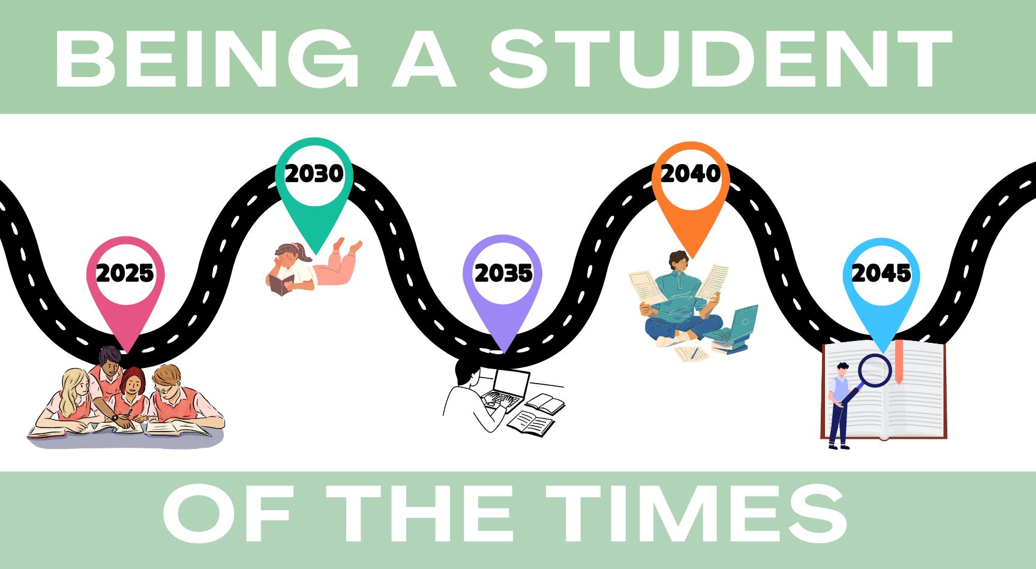
Being a Student of the Times comes with several important guidelines that need to be front and center in your mind to be effective. First, one must consider and respect the positions and situations of others. You have heard the statement about the difficulty in “trying to walk in another person’s shoes”? A high-quality Student of the Times requires one to switch places with others and see everyone’s point-of-view. Second, don’t expect your friends, colleagues and co-workers to know what you know. Assuming in this area means you can read their minds and Being a Student of the Times will let you know this position is not correct.
Finally Being a Student of the Times will force you to better acknowledge that the forever growing information-overload phenomenon exists everywhere and thereby makes most critical issues only truly a priority at one point in time. Plus with the expanding social media presence… it is appropriate to recognize that not everything you hear/read/view online is accurate, truthful and/or deserves your professional attention.
Bottomline: Being a Student of the Times will better position you… your business… your organization for tomorrow. Study well!!
TRIPLE III TIME: A Workshop On NETWORKING
As we all realize…continuous improvement and life-long learning often requires revisiting special important topic areas from time-to-time. So as I was talking to my American Government & Politics class recently about establishing and building a solid professional network of friends and colleagues… the last question I thought I would be asked was: “Well sir… if you were teaching A Workshop on NETWORKING to our graduating senior class… what topics would you cover?”
YES… I was caught off-guard! But yes you probably all know I carry a bunch of yellow legal pads with lots of notes… so I was ready to answer the question. And just for tradition-sake… I drafted customized concepts for A Workshop on NETWORKING in my own TOP 10 fashion!
- Be aware that NETWORKING occurs everyday and everywhere you converse with people. Never waste an opportunity.
- NETWORKING quality should not be measured by someone’s credentials. Let them be authentic.
- Ideas and innovation are natural outgrowths of NETWORKING.
- NETWORKING allows you to learn a little more about what you don’t know and avoid being wrong about an issue.
- Good advice and support via NETWORKING can be high value no matter someone’s age.
- Your professional reputation can be enhanced with solid NETWORKING connections.
- Gaining linkages to specialists in multiple fields is a NETWORKING outcome.
- Developing professional NETWORKING connections…causes one to uniquely test your relationship-building skills.
- Sharing in a variety of ways is the essence of NETWORKING!
- This is my favorite: NETWORKING helps make your ideas and events better.
Well the class probably got more information than they expected…but surely it was a lesson worth learning.
I hope at least one TOP 10 helps you be a better professional tomorrow.
TRIPLE III TIME: Disruptive Innovation
Last week our TRIPLE III TIME message was all about: Quality Control – The Little Things Matter. In it I talked about a TOP 10 list of very basic, common sense and professional courtesy driven actions… that if employed regularly, would heighten personal and organizational quality outputs. Ultimately, it was/is my hope that if appropriately applied… all aspects of one’s operation would improve!
Now as a next step in professional positioning and growth… I want everyone to think about: Disruptive Innovation.
“Disruptive innovation, a concept developed by Clayton Christensen, describes a process where a simpler, cheaper, or more accessible product/service starts in a small or new market, eventually moves upmarket, and displaces established competitors. It typically targets underserved customers and makes a formerly complicated or expensive product affordable for a broader audience. This process leads to a new market and value network that ultimately disrupts an existing one.” (Google-AI)

Consider the product you produce or the service you provide. Has it been impacted by Disruptive Innovation? Consider the job search arena. Has Indeed, Trillium, Kelly Services, and Monster changed the government funded employment services system?
Has simple cost and convenience altered how citizens search and find new jobs? This example of Disruptive Innovation is just a means of getting your professional development attention and in some way energizes a little creativity in your worlds-of-work.
Disruptive Innovation most often asks you to first return to the service/product problem you are trying to solve for your customers. Can you break it into smaller pieces to ease understandability? Could you make it easier to access…with or without technology? Is it as customer-friendly as it can be…or has high-tech made it a “distant-reach” for your customers? Does your service/product methodology ask customers (and even staff) to go too far too fast??
Finally, understand that Disruptive Innovation does NOT tell you how to do what you do differently. Rather it just asks that you THINK DIFFERENTLY to maybe start new initiatives aimed at solving old problems in smaller, cheaper, simpler or in more effective and efficient customer service ways.
Hopefully this message helps with customers lost… customers missed…and new customer connections!
LEARNING MOMENTS Podcast: Building Indispensability
When you think about professional development, sometimes you need to look in the mirror and consider you… your business… and your organization’s current and long-term value in the marketplace. Are your services… products needed, and growing… or fading and sliding toward that “obsolete” category?!
This Building Indispensability podcast is meant to encourage everyone to self-check their value in the workplace and customer needs arena. This assessment should be a natural business/organization/personal exercise to ensure appropriate changes and progress actions are taken to continually place you and your group in that “you can’t be successful without me” category!
Enjoy the listen.
TRIPLE III TIME: Quality Control – The Little Things Matter
No matter what employment sector you work in…there is a common…important need for Quality Control. Even if your job currently is being a high school student. The quality of the homework you complete and/or the way you conduct yourself in the classroom…all can be labeled a different form of Quality Control.
I’m guessing you are forming a quick understanding of the: Quality Control – The Little Things Matter…focus for this week’s TRIPLE III TIME message. Tell me if your thoughts follow these special TOP 10 examples:
- Return phone calls or online messages in a timely manner…it is an important personal responsibility.
- PROOFREAD what you write or send…your words are a “vision” of you.
- Provide adequate notice for future assignments or meetings…it is professional courtesy.
- Meet deadlines for work assigned…don’t follow a “that’s close enough” approach.
- In our electronic age…confirm receipt of information/messages…don’t make the senders assume receipt.
- Try to guarantee accuracy in your communications…inaccurate “pass-alongs” to multiple people can cause endless problems.
- Voice tones in the delivery of written or oral directives have more Quality Control impacts than most realize.
- Don’t question yourself when over-sending information to people…because under-sending and leaving people out would be a bigger issue.
- In all areas of what you do and how you do it…commit to a Promises Made-Promises Kept routine.
- Finally…although it sounds little in function…always try to do one extra “progress thing” each day (more ideas/insights/information/initiatives/inspirations).
Somehow this TOP 10 list of Quality Control – The Little Things Matter doesn’t really seem so “little”!
TRIPLE III TIME: “Entrepreneurship is a Way of Life!”
First, I want to be clear that I have not shared anyone’s email as complete a TRIPLE III TIME message before…only quotes and/or paragraphs. However as you will read this email message from a very good friend, you will realize it is a unique testimonial to “my way of life”! Therefore, for professional confidentiality sake and sharing it with total word-for-word accuracy… I have made no changes to JG’s excellent document!
I feel privileged and proud to share this with you:
Rural Michigan: The Next Great Frontier for Entrepreneurs
While the world races toward urban tech hubs, I see a different kind of goldmine, rural Michigan.
Not in the form of apps or algorithms, but in community-rooted entrepreneurship, in people with grit, creativity, and deep ties to their land and neighbors.
Rural Michigan is brimming with untapped potential:
🌾 Family farms ready to diversify.
🏪 Main Street businesses needing new energy.
📦 Supply chain gaps waiting to be filled.
📡 Tech deserts begging for innovative infrastructure.
And above all, young people hungry to create, not just consume.
What if we stopped viewing rural communities as places to escape from, and instead saw them as launchpads for new venture creation?
What if we:
1️⃣ Invested in broadband AND business incubators?
2️⃣ Built entrepreneurship high school pathways in rural districts?
3️⃣ Incentivized rural innovation zones, not just urban ones?
4️⃣ Put real capital in the hands of rural founders, especially women, veterans, and first-gen students?
Entrepreneurship isn’t just for Silicon Valley. It’s for rural towns across Michigan! It’s for people with vision, values, and roots.
Michigan’s future will be brighter when we stop treating rural as a challenge, and start treating it as a competitive advantage.
Let’s grow the economy from the ground up.
Literally.
“Entrepreneurship is a way of life.”
TRIPLE III TIME: “Observational Research”

Sometimes in my roles as a consultant or an educator a need arises to conduct a small bit of active research to offer a client “the better way forward”. Typically it is understood that the research is not the only factor involved in making an appropriate decision regarding a change in current organizational operations. Rather the goal is to gain a more in-depth snapshot of individuals…a group…or a certain setting to make sure of the accuracy of factors impacting what you may or may not want to change.
Why is “Observational Research” an important TRIPLE III TIME topic?
The intent of this “Observational Research” message is to encourage everyone…no matter your job…to occasionally apply this form of “natural assessment” to stay up-to-date with current product/service expectations. You don’t have to be a degreed scientist to do “Observational Research”. Instead, just keep your special study simple. Prioritize these points:
- Decide what do you want to know.
- Decide what you need to observe and for how long.
- Keep resources in mind. Both time and money!
- Analyze only what you observe…but include newly discovered insights.
Remember “Observational Research” can be a more quick and efficient way of gaining evidence-based information for planning or decision-making purposes. Also keep in mind that the purpose of “Observational Research” is to learn more about a certain organizational activity or issue…but not to make comparisons. Finally, when I utilized my simple “Observational Research” methods…it didn’t matter if a few issues changed during my study time. Instead it forced me to stay focused on my original “what do I want to know” goal!
Basic “Observational Research” is a useful administrative/management assessment tool. Try it!
 Inspiring Innovations, Inc.