Author Archives: Inspiring Innovations, Inc.
TRIPLE III TIME: Don’t Lower The Bar
Sometime… somewhere we have all heard the phrase: “Don’t Lower The Bar”. And if discussed in a professional development situation… the phrase most often refers to lowering the standards/expectations that need to be met to qualify for something. So as a consultant advising business or organizational leaders… do you think there would ever be a time or event that would push me to suggest “lowering the bar”?
Working with people no matter the job or the position you hold is one of the toughest professional tasks. And although there may be decision-making moments that would offer positives if lowering the bar of requirements were made. In the long-term however… any precedent-setting action of lowering qualification requirements… may cause multiple non-progressive results.
What challenge/results am I referring to? Check out the following TRIPLE III TIME “Don’t Lower The Bar” concerns:
- Lessening the number of learnings needed to attain certain credentials.
- “Squashing down” the time needed to certify total completion of requirements.
- Taking “assumed-learning” as “good enough”.
- Convincing yourself that more experience will fill-in the learning gaps.
- Not worrying about your own credibility when you sign a certificate of completion or letter of recommendation for someone.
- Remembering that job orientation/on-boarding learning normally occurs just once.
- Finally, regarding awarding promotions and advancements, lowering the bar based on employee longevity… existing degree status… or friendships and company/agency loyalty… can often result in unfortunate outcomes.
Applying the “Don’t Lower The Bar” principle may be difficult in some unique categories. However it has been my career-long experience that maintaining and maybe even RAISING THE BAR of professional standards/expectations… can produce quality progressive outcomes in creative ways!

TRIPLE III TIME: Using the Wrong Equipment =’s Creativity?
“Finding ways to work with the wrong (or old) equipment can be a boost to your creativity!” (GREAT TED TALKS, Tom May, 2020)
Did you ever want to just throw your computer out the window when you push the wrong button and the screen goes blank?? Or maybe it took you 40 minutes to type the “perfect” paragraph and suddenly the battery power in your computer is gone and you effectively lose some important information? It is at these moments that Mr. May’s quote pushes me not to always rely on what a computer can do for me on “ITS” terms… but rather find a way to get more out of technology on my own creativity terms!
I describe my challenges with computer usage as a lead-in to this week’s TRIPLE III TIME message: Using The Wrong Equipment =’s Creativity! It is a real-time example of taking a little extra time… reinforcing patience… lessening the need for “perfection” and taking an alternative techno-approach to motivate innovation. Did the experiences I described make me try a little harder on improving my initiative and focus better to complete my project… yes it did. Was computer technology for me the wrong equipment for what I was attempting to write… yes. But did it challenge my creativity to make it work for me in a different fashion… YES!
The goal of this week’s message is to help everyone consider different forms of “wrong equipment” that you experience (more Marv examples: foam brushes, sledgehammer, virtual meetings, hand saw, cell phone, online book and pest sprays) and consider the creativity capacities it may ignite. Think about:
- Repurposing equipment/tools to invent an alternative purpose for them.
- Using wrong equipment in a totally different manner (especially computers) to get more out of them.
- Lessen traditional stereotypes regarding wrong/old equipment and tools and realize: “They ain’t as bad as I thought”.
- And/or in a unique kind of way…think about applying the Using The Wrong Equipment =’s Creativity message with regard to people you work with/employ. Maybe someone is the “wrong equipment” for one job…but may be absolutely great in another employment area. Creativity…right?!
Tom May offered a great, thoughtful quote. Make it work for you!
LEARNING MOMENTS Podcast: “Positioning” Through Innovation & Entrepreneurship

It is always extra special to prepare the November 15th Inspiring Innovations, Inc. Learning Moments Podcast! Whether it’s because of my hunting blind recording location or just remembering some of my Dad‘s traditions, the messages I prioritize just seem a little more personally important.
“Positioning” Through Innovation & Entrepreneurship is a professional activity that will make a positive difference no matter your employment responsibilities. Scheduling time to consider: Customers Then – Customers Now, Communication (2 Elephants in the Room), Partnering In & Across Boundaries, Creating An Idea Mill, Building Non-Traditional Products/Services and using PROFESSIONAL DISCOMFORT via Continuous Improvement… are all priority “Positioning” categories to consider!
Have a fun listen and we will discuss more next month.
TRIPLE III TIME: Realizing What People “Don’t Know”!
Today one of the most important points I have continued to experience more and more in my consultant role is: Realizing What People “Don’t Know”! Now don’t start thinking that I am claiming to be smarter than everyone else. No…not at all. Instead I am learning and experiencing more often the fact that it is very difficult to simplify the tasks assigned to every job today…thereby creating challenging knowledge gaps.
Think about it. Think about the injection of all kinds of technology, social media, new internet-related terms, workplace location issues and online deal-making processes that impact EVERY job. These multiple factors of new-age understanding may be referenced in updated job descriptions…but how they appear and operate in ones everyday world-of-work will not show-up as basic nor simple.
Also there is the growing problem of “two-way-assuming”. What do I mean by “two-way-assuming.”? By “two-way-assuming”…first I BELIEVE the individual or group I am working with fully understands what I am talking about when I describe something like “intrapreneurship”. Then at the same time THEY BELIEVE…(i.e. assume) they know what the learning message is? The end result is that because a “two-way assuming” situation has been introduced…there are one, two or more knowledge gaps that result in poor performance or mis-guided agency action.
What’s the remedy?
My long-term college professor and mentor has reminded me more than once “that to be effective as a consultant…don’t assume anything”. For me this advice has always pushed me to take extra professional moments to ensure I am Realizing What People “Don’t Know”!…so that my efforts to help them go forward are better focused and thereby more effective. Likewise always providing strong two-way communication…even on things some people see as simple…may make the difference between good products/services…and GREAT ones!
A U.S. Constitution: Volume II
This quarter I took a more direct non-traditional, innovative approach in writing my American Society for Public Administration (ASPA) article. As you can guess from reading the articles title: A U.S. Constitution: Volume II… I offer a number of strategic updates and thereby recommend an expansion of the Founding Fathers original document rather than a series of amendments.
In the article, I briefly share my purpose and rationale for the need for A U.S. Constitution: Volume II and the target areas I believe require the most significant upgrades. Do I get political… some would say “kind of”. Instead, I would say that as a career, long public servant, I believe a restatement or a New Century’s Declaration of Responsibilities for the US government was more my professional goal for the article.
I will admit the topic is “heavier” than most of my ASPA contributed articles. However, our times and positioning as a country… easily drive my idea.
As a career-long public administration/public service professional, the U.S. Constitution has been a consistent point of reference and organizational stability. Even prior to assuming the role of community college American Government & Politics course instructor, my relationship with the Constitution was one of continuous respect and righteous rule making whenever needed. And although the initial document has understandably been amended twenty-seven (27) times over the last 250 years, its principles have honorably “stood-the-test-of-time” no matter the challenges.
Now it is the year 2025 and it has been only recently that I have felt that the country needs “A U.S. Constitution: Volume II”. I believe this need is driven by the ever-growing number of non-traditional interpretations of what the Founding Fathers meant and believed. These mis-interpretations have negatively impacted States rights, the true role of the federal government and caused the highest level of political division our country has experienced. Additionally on an international level, foreign neighbors have been placed in an unnecessary “competition” position where money…not peaceful existence is the operational priority.
 The balance of this American Society for Public Administration article will be dedicated to discussing some of the most appropriate and timely U.S. Constitution: Volume II review and upgrades. The intent of the improvements would be to assist in maintaining a quality Checks & Balance/Separation of Powers operational system within our government as envisioned by the Founding Fathers and assumed by the citizens of the United States. These upgrades would not take the form of an Amendment to the Constitution. Rather it would be prepared as a Volume II document…as an “expansion” of the original. Driven by the many geographic, technological, historical, scientific and humanitarian accomplished changes in our world.
First let’s consider the upgrades that would be appropriate to forbid the U.S. from ever allowing the country to accumulate over $30 trillion dollars of debt. This situation would never have been perceived nor allowed by our Founding Fathers. Fiscal integrity and minimal/simple federal expenditures would have been the presumption. Hence, one Constitution: Volume II upgrades (which would not require any retractions from the original document) should target qualified improvements that would downsize U.S. government spending and hopefully slowly decrease the national debt we have encumbered. Painful…yes…possible…yes. Additionally Constitution: Volume II adjustments would indicate that no single branch of government could take action that would impact more than 10% of any Department’s service activity. Fiscal integrity would require a more integrated decision-making practice and thereby limit over-action by a single person or single branch.
A review and upgrade of the Constitution’s current language regarding separation of States rights and the rights assigned to the federal government would also be a priority. Although the Constitution goes to great lengths to ensure “who can do what”…we have had a Civil War and current challenging times seem to almost encourage some form of similar action in the future. Minutia-style interpretation of the Constitution’s assignment of power and responsibilities has in so many ways weakened the historic principles of the Founding Father’s hopes for continuous collaboration of government at all levels. Whether the challenge is police powers or international trade…a common sense, interpretation-resistant Constitution: Volume II upgrade seems to be a correct systems improvement action.
Immigration is another national policy area that is in immediate need of Constitutional “re-writes”. I don’t believe our Founding Fathers could have ever envisioned our country’s expansion, diversification and honor from other country’s citizens to want to be part of our United States! These “growing-pains” have again left our Constitutional system open to periodic “re-interpretations” of what the best laws/policies should be…without modern-day upgrades. A Constitution: Volume II upgrade would/could provide the necessary commonization of immigration advancements to be made and then be enforced in a strong limited fashion.
Technology and science in general are two additional major reasons to engage in “A.U.S. Constitution Volume II review and upgrade! I can’t nor couldn’t identify all of the various factors that in some way appropriately accentuate the need to pause and modernize our Constitution. The technological advances that are occurring not only in the United States but all over the world is a progressive continuous improvement reason to review and upgrade segments of our Constitution. Simple communication processes are no longer simple nor “saddled” with multiple delays. As a result, adjustments to the Constitution that reflects technology as an ever-improving tool for governmental operation, would improve/modernize our country’s position world-wide.
Unlike so many governmental reform actions that are/have been taken across the United States, this Constitution: Volume II concept in no way recommends “erasing” any part of our past. Instead it is intended to progressively recognize our growth. One-by-one Amendments to our Constitution would not perform the necessary strengthening upgrades we need to make as a whole. Population growth and diversity, technological advancements in every field of service, strengthening of fiscal responsibility and correct reinforcement of our shared governance between the three branches of our democracy…all are factors that would demonstrate: A U.S. Constitution: Volume II as a great step forward.
TRIPLE III TIME:
Coming up with new, non-traditional and/or innovative ideas… has never been a problem in my professional world. However, when the time came and I was trying to figure out the best and most promising way to get the concept moving… very often I “hit” a roadblock. And I am not talking about money or even staffing… rather it was a matter of surrounding myself with common-minded people anxious to do something new.
So with that thought in mind, I want to toss out a solid, fun progress TRIPLE III TIME action: Try “Crowdsourcing” Your Idea. And just to get everyone on the same page… the definition of Crowdsourcing is:
“The practice of obtaining information or input into a task or project by enlisting the services of a large number of people, either paid or unpaid, typically via the internet.” (Oxford Dictionary)
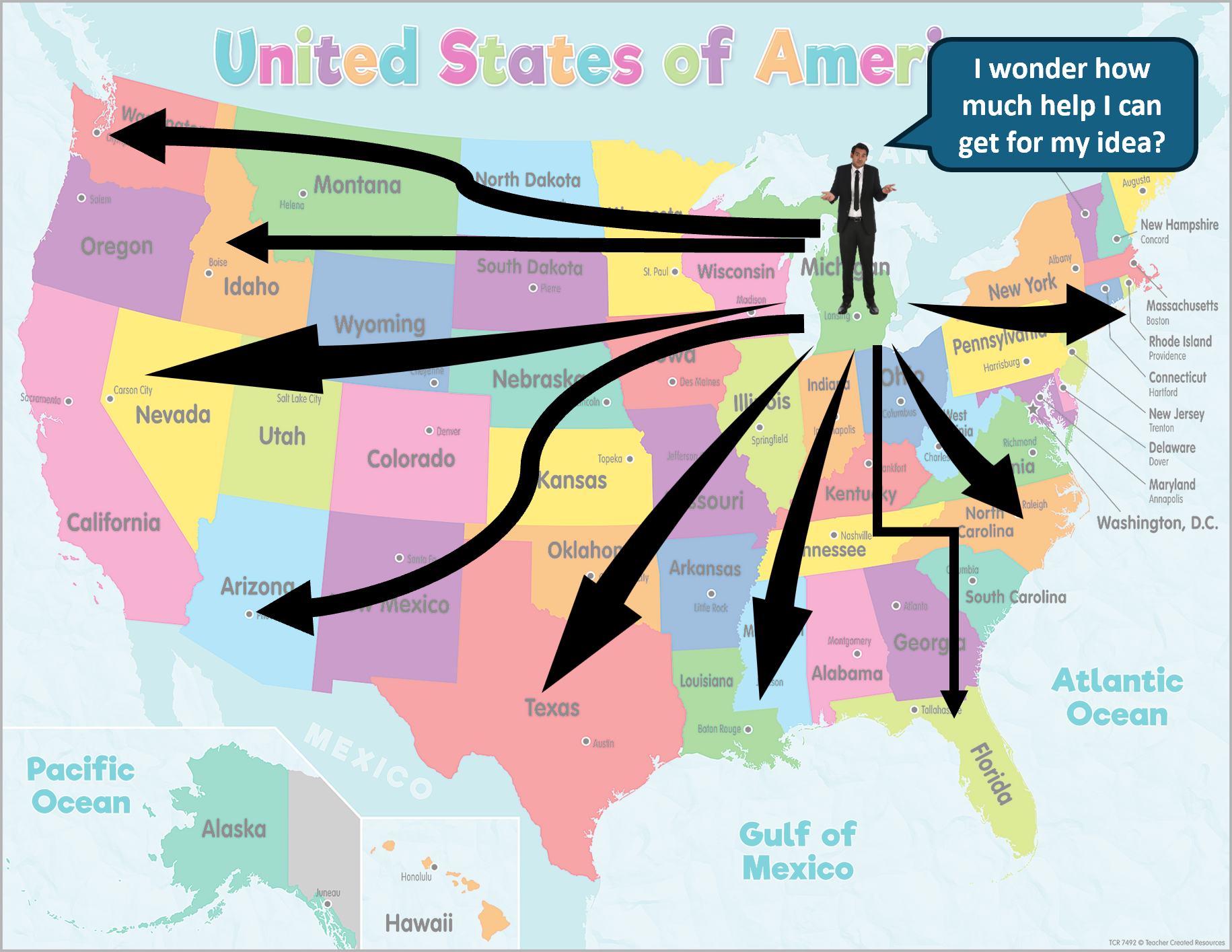
Today, Crowdsourcing your ideas is not just an imagination-spreading way of garnering support for your project/plan, but an additional way of “testing” its support-ability in the public or private business sectors.
While in my Inspiring Innovations consultant role, I have spent additional customer time stressing that no one achieves progress alone… even during the project development stage. Idea-blending, market-targeting and customer-attracting are all Crowdsourcing activities that can make or break your new hopeful creation. Whether in-person or online, by Crowdsourcing your idea, the potential for gaining extra, unique, manageable information as you move forward will have real high-value impact.
Bottomline: If you have not considered it before: Try “Crowdsourcing” Your Idea. Or if you have only tried it on a small scale… give it a larger try! With the complexity of today’s product/service markets… having a group of interested, caring minds willing to contribute… is a great opportunity you don’t want to pass up.
TRIPLE III TIME: Strengthening The “WHY” In What YOU Do!
In high school and even when I started college (by orders from my parents) most of my career thoughts were about partner farming with my Dad and brother. Even as I half-heartedly took classes my first and second years…I still wasn’t real serious about a specific job interest nor what a college degree would do for me. But the more part-time jobs I took and the quality connections I made at every development turn…the more I realized the satisfactory smiles I attained just helping people.
So now as I look back and consider all of the non-traditional steps/actions I took to spend my entire career working for the cause of helping people…the better I understand that just helping people was the “WHY” driver in my work-world. And now for this TRIPLE III TIME moment, to share special thoughts about: Strengthening The “WHY” In What YOU Do!
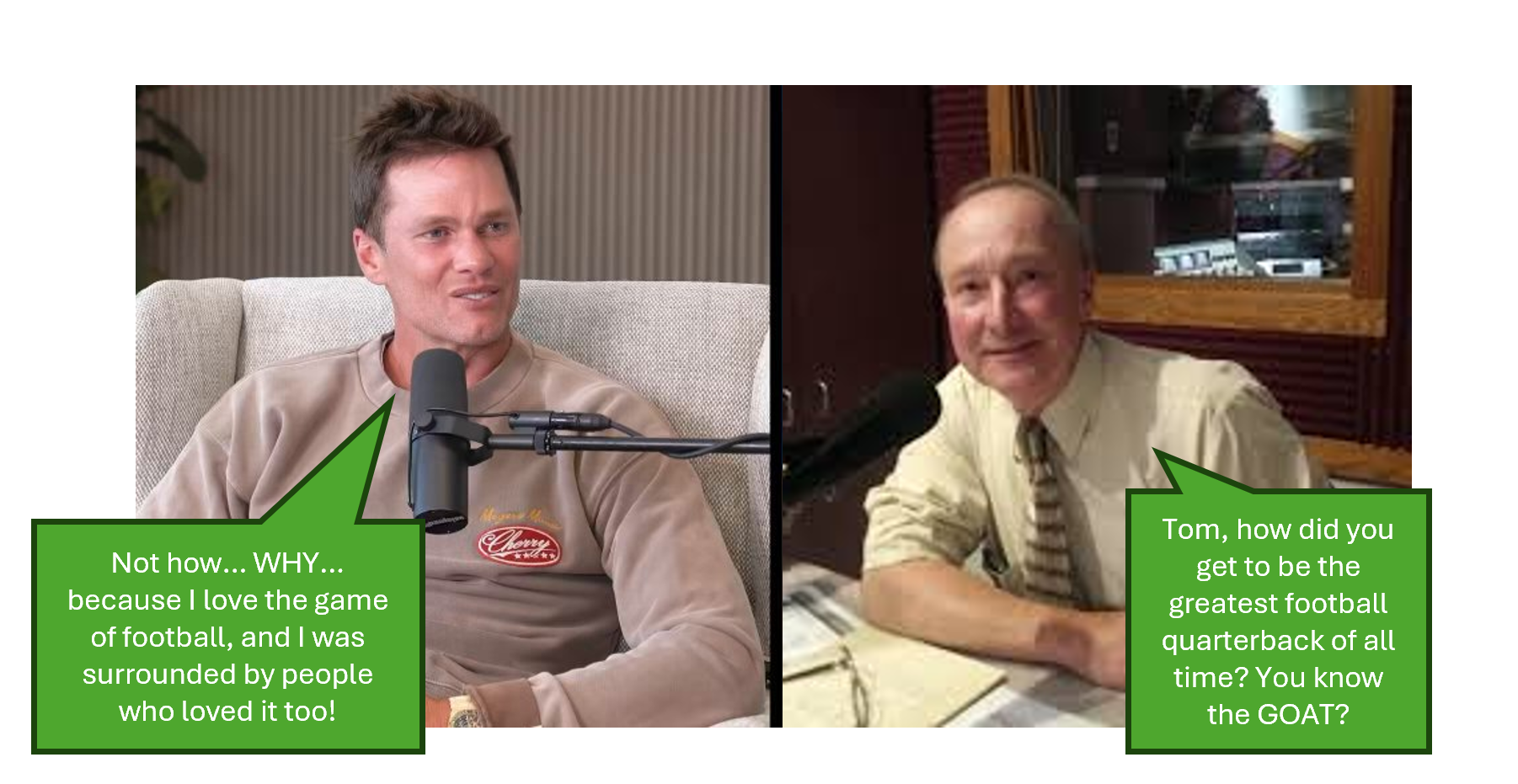
First start by growing past that “it’s just a job” mentality. Too often people take this approach/attitude and do the minimum to make the it’s just a job”…a total reality. It is totally up to you to develop and show a special kind of energy for your “WHY”…that no one else in your workplace can replicate.
Second begin looking for and connecting with others that have similar “WHY” this job is especially right for me…right now approach. You really will never know when the chance meeting opportunity will occur…but often it finds you! Ideas, hobbies, philosophies, products, colleagues and priorities uniquely find their way into your conversations. The result is that your “WHY” purpose gains greater satisfaction and creativity.
Third, take advantage of these no cost high value connection opportunities. You will find that the new network partners will appreciate when you “take-advantage” of their skills and knowledge and then how it happens naturally in reverse. But remember you must let your “WHY” job/career thoughts be clear and thereby allow more open conversation to take place.
I can’t think or even guess the HUGE number of lifetime opportunities and privileges I have experienced when connecting with those who share my professional “WHY” and my enthusiasm when innovating “with-my-own-kind”! They represent a special kind of professional development and by Strengthening The “WHY” In What YOU Do! will better build that progress element in your world-of-work everyday…EVERYWAY!
TRIPLE III TIME: Do YOU Get Defensive?
“When we create a culture that rewards collaboration and cooperation, we actively encourage our team members to behave in that way. When we reward aggressiveness, this spreads throughout the organization like “a virus”. And while it might seem productive to create a red zone filled with star performers, eventually these individuals will be more concerned with trying to take each other out. Your star performers will very quickly become less than average.” (Jim Tamm: Cultivating Collaboration)
Do YOU Get Defensive? I will admit freely that as a life-time innovator and idea person…early in my career I would get quickly defensive if someone questioned my concept or new way of “getting-the-job-done”! It would be easy to hide behind the excuse that it was just human nature…right? However, it didn’t take me too long to realize that by getting defensive…I often drove colleagues away and maybe even lost their always needed support.
It is critical to realize that there are absolutely NO positives in taking a defensive posture on anything. Co-workers will not want to work with you. Bosses will treat you in a guarded way and not include you in high-value discussions. And customers will “keep their distance” if you get defensive even when they just ask a regular product/service question.
Finally if you apply the Do YOU Get Defensive? question with regard to your style as a leader…do you see yourself as open to questions…comment and/or critique? And don’t compare being defensive…with being confident. Your conduct/messaging will be worlds apart in how it is perceived by others.
Remember being defensive will always put you in the NEGATIVE category.
Learning Moments Podcast: Applying Decision “Weights”
This month’s Inspiring Innovations LEARNING MOMENTS podcast is all about trying a “Weights” system to improve your life and workplace decision-making process. Is the podcast message a little confusing… yes…but so is basic decision-making. Does every decision include “weight” factors that vary based on the occupation you have, the business you own, how old you are, where you live and the people you trust to give you great advice? I told you the podcast makes you really think!!
My 1-5 Weighting System recommendation does not make decision-making much easier. However, I believe it will give you insight as to what factors most influence a certain decision. Then YOU have to decide if you are giving all considerations a fair contribution to the decision… or just one or two major ones.
Enjoy the listen a couple times!
TRIPLE III TIME: “Right?-Wrong? Or Gray?”
 Inspiring Innovations, Inc.