Category Archives: COMMUNICATION LIVES
TRIPLE III TIME: ONLINE PARTICIPATION (What If I Don’t?)
 Today within this special TRIPLE III TIME message I want to share with everyone the feelings one has when they are asked a unique professional help question that they would NEVER have seen coming! The question: “Dr. Pichla will you help us with a workshop/training session on how to increase ONLINE PARTICIPATION in our organizations activities? Can you picture THE LOOK!? Me…who avoids online anything and lives to be face-to-face for professional positive energy and performance quality!
Well maybe they asked me specifically for the reasons I just wrote (and maybe it would help me too).
No matter the business or service sector you are working in, the need to be involved in online meetings, education, training, sales, performance measurements or planning must include EVERYONE. I think it is also important to point out that regardless of the impacts the COVID pandemic has made regarding this issue, use of advanced technology for all the daily activities identified above…and in a much bigger way…is/was just around the corner.
Given this unavoidable ONLINE PARTICIPATION phenomenon and in response to the NEVER question, I would build my workshop/training session around answering several very direct “onlining” questions:
- Does participating in an online meeting mean you can pay less attention or ask less questions?
- Does conducting an online training mean as long as you get through your slides…all is good?
- Who is responsible for participation quality in an online world?
- How do you eliminate ONLINE PARTICIPATION “hiding places”?
- Does participation…real participation take on an expectation of leadership?
- Should lack of quality personal ONLINE PARTICIPATION have economic impacts?
- How would it feel to NOT be included in an ONLINE PARTICIPATION business growth session?
- Try to describe “all-in” when you think about ONLINE PARTICIPATION?
- How do you get labeled “the best in the business” in the ONLINE PARTICIPATION category?
- Is it appropriate to pick and choose your attention level regarding ONLINE PARTICIPATION?
We would have fun and together learn a lot?
Bottomline: I would remind them that the best answer to QUALITY/GREAT ONLINE PARTICIPATION for anything is found when you look in the mirror.
TRIPLE III TIME: RECRUITMENT 2022
There are so many critical personnel issues facing those responsible for manpower in businesses and organizations in today’s world of work. Candidate RECRUITMENT is often part of every consulting session I take part in no matter the private or public sector employer raising the issue. Understandably the majority of my ideas and recommendations are customized for every group. However, I have to report that no matter the entity…no matter the size of the company and no matter the service or product they supply, the initial question I raise regarding RECRUITMENT of workers is: “How old is your stuff?”
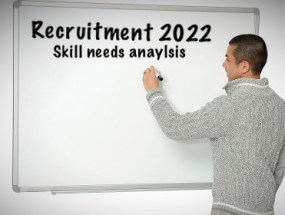 Specifically, how old are your job postings, the job descriptions, the media your use to get the word out, the recruitment methods used by your competition and finally is the position you are recruiting for really the specific area your organization needs help in? Too often companies or agencies practice RECRUITMENT BY CONVENIENCE! Instead of doing appropriate employee skill need research…those responsible follow traditional RECRUITMENT and hiring practices (i.e. the most convenience option). The end result is that the person hired may be great…but the job expectations may be much different than what was advertised and discussed thereby creating early two-way confusion and the potential loss of a good person.
Today more than ever before every organization should avoid RECRUITMENT BY CONVENIENCE. Everything…YES EVERYTHING has evolved, modernized, gone high tech and become more job task specialized. Therefore, I recommend that before even launching a personnel RECRUITMENT campaign, conduct an employee skill need analysis with the future in mind. It will be more than worth your time.
TRIPLE III TIME: “If You Are NOT OUT THERE… Then You Are NOT IN!”
Well if you have not paid attention or missed some of the pickups parked on the side of the road near a patch of woods… it is deer hunting season! And one of he “sayings” related to this season I have heard over the years was: “If You Are NOT OUT THERE… Then You Are NOT IN!”
What does this statement mean to those involved in deer hunting?

Simply it means that if you: (1) sleep-in, (2) decide it is too cold, (3) watch a movie, or (4) go to work on an overdue project; you will not be out in the woods and not seriously be in the hunting game for the necessary times that are available!
OK go ahead… now ask how does all this special information add up to a quality TRIPLE III TIME message?
Well I believe this statement: “If You Are NOT OUT THERE… Then You Are NOT IN!” also very appropriately applies to the need for timely, dedicated, workplace COMMUNICATION. Whether you are in private business or offer services in the public sector, if you fail to have a regular, strong and even unique process for getting your message out to those you work with or work for… you are really NOT OUT THERE and thereby NOT IN the game of effective successful COMMUNICATION.
Just like getting your hunting blind/food plots ready, communicating regularly in a quality way sets you up for better business/service opportunities. Also building in diverse methods of communicating within your workplace network can also enhance your potential of “being in the right place at the right time” (also a favorite deer hunting saying).
Bottomline: Be OUT THERE with great COMMUNICATION and you will be IN with greater business/service success.
TRIPLE III TIME: Communication: How Much Is Enough Or Too Much?
I don’t have to tell you or explain why EVERYONE in all walks of life are facing Communication: How Much Is Enough Or Too Much… challenges. Challenges like:
- What is the best communication method to use in certain areas?
- Who gets included in some emails or not others?
- Is it still OK to make your own handwritten sign and just put it in the hall?
- Are some issues still a “secret” to communicate when there is nothing secret about them?
- Is there short and long-term value in just giving most messages/information to everyone?
- How do you avoid having people think your messages are NOT that important?
The list of communication challenges questions is endless. However, this TRIPLE III TIME message is intended to offer some common sense communication challenge “helpers” to maybe use everyday… EVERYDAY!
First, no matter your personal/professional role or the goal of your communication… YOU are the LEADER. Content, distribution and timing are all in your court… so grab this responsibility opportunity and be decisive. Developing a style and standard for your communication will cause message receivers to look forward to your information and be more prepared for its distribution.
Second, in terms of distribution, I have always been more successful when siding in the area of INCLUSION. Eliminating the occurrence of co-workers or colleagues claiming “I didn’t receive that message” … or “no one told me” … is worth the extra effort of ultra-sharing action!
 Finally, in addition to SIMPLICITY… AUTHENTICITY matters. There is nothing wrong with a colorful handwritten sign or message! People appreciate passion, caring, involvement, commitment and personal interest… especially when they can receive a custom visual!
Every communication responsibility is unique. But if you keep the terms: LEADER, INCLUSION, SIMPLICITY and AUTHENTICITY strategically in mind… you will be fine.
TRIPLE III TIME: A Communications SUPPLY CHAIN?
Somehow it seems like the QUALITY of personal and business communications has never become more important everyday…EVERYDAY! Likewise, the challenges we face with regard to high level sources, volume and speed of communication have never been more intertwined. As a consultant/creative advisor to individuals and organizations, I continually stress that QUALITY communication overlaps/impacts everything. So this weeks TRIPLE III TIME message asks everyone to consider: A Communication SUPPLY CHAIN!
First, check out this simple diagram:
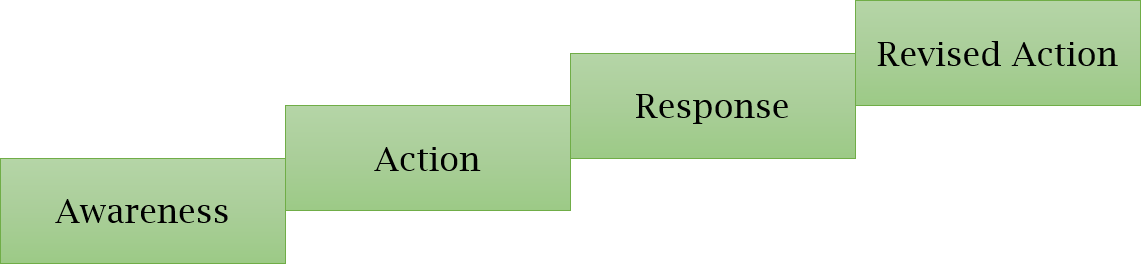
In order to be effective, I believe the communicator must decide where their message falls on the SUPPLY CHAIN. Are you just creating Awareness of an issue or asking for Action too? Determining where your message “fits” on the SUPPLY CHAIN will help in crafting it for clarity and timeliness. If you (the communicator) take a moment to deliberately consider where your message falls on the SUPPLY CHAIN, it will appropriately be more defined, targeted, and simplified. Too often time, energy and resources are wasted rehashing old or confused messages. Deciding early if your message is for Awareness…or an Action…or a general Response…or a Revised Action will enhance communication simplicity…and yes QUALITY!
Taking responsibility before and as you communicate to consider your message’s placement on the SUPPLY CHAIN is a leadership job! Don’t allow communication sources, volume and speed to confuse the QUALITY of your messages. Understandably, everyone has different communication styles. But if we could all use A Communication SUPPLY CHAIN as our common guide…I believe QUALITY would result.
TRIPLE III TIME: “Please Pass the Positive”

Photo via: https://www.pgeveryday.com
In the book Mavericks at Work by William C. Taylor and Polly Labarre, one quote that stands out is: “A solution is what results when you stop thinking about the problem.” So, although I know most of you were assuming I would be connecting Thanksgiving Day with the TRIPLE III TIME “Please Pass the Positive” message title ….but how about if we study the quote first.
Think about it. Even when you ask someone simply: “How is it going?” …how often do you hear primarily about a problem? I believe that unfortunately we bring up the negative first…and then problems take up the larger portion of any discussion. This bad habit also exists in every news cast and usually is the headline in most newspapers. Wouldn’t it be refreshing to hear a newsperson begin their program with: “Today insert school name reported 100% attendance for the fourth day in a row!” Or “We want to salute all of the US Navy sailors on the U.S. insert ship name who have been on an ocean assignment for over six (6) months…Thank you so much!” Starting with the positive…not the problems…just creates smiles.
So as you sit down at your Thanksgiving Day table, how about if you start a new tradition and ask everyone to first: “Please Pass the Positive”. And who knows, if we stop thinking so much about problems, positive solutions may show up before Christmas.
TRIPLE III TIME: The PRIORITY PICTURE
 In recent staff/organizational development discussions…the “how do you get better at prioritizing for your workplace?” has been a primary topic. I first told them I believe the improvement approaches vary by individual…but to get a better visual of the prioritization challenge the group had fun taking part in a couple mind exercises.
First, I asked the group to think about all the messages they receive each day via telephone, in-person, email, newspaper, television, social media, etc. And consider each message as a “sticky-note” …color coordinated by source…all placed on a white board. There were laughs and gasps…but all seemed to understand how overwhelming that would be for just one day. The exercise concluded when I asked them to view their imaginary boards and determine if they can see specific priorities coming through…or are their boards more like those pictures that you can’t see an image unless someone points it out to you?!?
Think about it!
The second exercise had everyone visualize your messages trying to be funneled into your brain…and a smaller “pipe” showing priorities exiting your brain. Again, the giggles…but more importantly was the realization of what do you do with all of that excess messaging information taking up space in your mind?
This is another time management area where SIMPLICITY MATTERS! As messages come to you it is critical to ask: What is wanted or needed to make it a priority…before making decision room for details. Also, identifying the timeframes for action is a screening tool for priority setting that will assist in opening (or closing) the messaging input funnel. Additionally, it is YOUR responsibility to inform message senders of your process for priority setting and that they too must understand that SIMPLICITY MATTERS.
TRIPLE III TIME: “Does Anyone Hear ME…US?”

Life working on the frontline often has a feeling of isolation. Most times your main line of COMMUNICATION rests with co-workers and first-tier management. Contact and discussion time with those at the top levels of business/organization operations are often infrequent and “courtesy-call-ish” in nature. The resulting personnel activity usually follows a common track:
- Internal complaining
- Business remains stagnant
- Work activity continues but…with minimal leadership influence
- Workplace “hiding-spots” develop for frontliners and top-level leaders (i.e. He or she is just too busy or “Does Anyone Hear ME…US?” anyway)
Well for this TRIPLE III TIME message…I am going to push the responsibility for COMMUNICATION in the direction of the frontliners. Think about these ideas:
- When did you last send a direct request for a meeting with the lead person(s)?
- Have you ever structured a formal agenda to share with leaders as part of your meeting request…IN WRITING?
- Because we live in a SHOW-ME WORLD… what new service/product/operation are you ready to show them?
- Do you make sure your request is all business and not a personal visit moment?
- If you work with a team…are they all involved in the leader meeting request idea?
- Are you prepared for whatever form of feedback may result (i.e. professional discomfort)?
- Is the information you wish to discuss progressive/action-based?
- Have you considered a very specific meeting timeframe (i.e. one (1) hour)?
- What meeting structures have you considered to make sure it can NOT become a whining session?
- Finally be sure to identify the 1 or 2 or 3 priorities for the visit (i.e. take-home ideas)
BOTTOMLINE: Leadership is a two-way street…and as frontline leaders it is more than appropriate for you to take the meeting request initiative.
 Inspiring Innovations, Inc.