Category Archives: SPECIAL TOPICS
TRIPLE III TIME: “Don’t Wait For Normal”
As I have commented in the past…I never know when and/or how inspiration for a special TRIPLE III TIME message may come. Recently I was fortunate to be part of an event that featured Tim Furlong (My Quarter Turns) as a special speaker regarding “Change, Opportunity & The Next Normal”. And as you can see from this week’s III message title: “Don’t Wait For Normal”…I was driven to address historic areas of normalcy directly impacted by Mr. Furlong’s presentation.
First think about change today. Change no longer is something that evolves over time or pops up from some intense discussions. No today CHANGE is a constant and must be blended into everyone’s daily way-of-life. I know all of you reading this are saying simply…”Yeah I know change stuff”. But just to make sure our “Don’t Wait For Normal” discussion topic is critically understood…let’s consider five (5) specific CHANGE areas.
Communication: With all of the advances that have occurred in the area of Communication…there will no longer be much “normal” in this change category! Speed, options and functionality will be at least daily factors when considering this “Don’t Wait For Normal” issue.
Employment: There is not a job in our world today that has and/or will be impacted by the usage of technology. Every sector…agriculture, manufacturing, retail, banking, safety…you name it, have all been revised in some way by creative techno-innovations. Also think about all of the “new” jobs that have recently or are still in the process of being created. “Don’t Wait For Normal” is good advice when considering the job market today.
Global Economy: Local, regional, state-wide, national and international locations are now the new age marketplace. Given all of the social media platforms…entrepreneurs in a wide range of product and service sectors have the opportunity to successfully take advantage of today’s “Don’t Wait For Normal” challenge! The globe is now everyone’s virtual storefront.
Education: Good or not so good…in-person, class-based education options are no longer the new norm. High school and post-secondary education opportunities are now available for access in your own living rooms and at any time day or night. New learning designs are being structured and offered at different training speeds and formats everyday. Change in this area really enhances the “Don’t Wait For Normal” growth strategy. In other words…the longer you delay development activity in the Education area…the further you fall behind.
Government: Waiting for normal in the Government sector…is an unrealistic advancement position. Today, both domestic and foreign groups are all “jockeying” for a better lead world-wide position thereby pushing the “Don’t Wait For Normal” reality option. Progressive collaboration, consistency and compromise are no longer the key considerations in facilitating Government operations.
One more time I want to thank Mr. Furlong for sparking the “Don’t Wait For Normal” TRIPLE III TIME message principle. I hope this message also sparks some positive personal and professional development considerations for everyone.
A U.S. Constitution: Volume II
This quarter I took a more direct non-traditional, innovative approach in writing my American Society for Public Administration (ASPA) article. As you can guess from reading the articles title: A U.S. Constitution: Volume II… I offer a number of strategic updates and thereby recommend an expansion of the Founding Fathers original document rather than a series of amendments.
In the article, I briefly share my purpose and rationale for the need for A U.S. Constitution: Volume II and the target areas I believe require the most significant upgrades. Do I get political… some would say “kind of”. Instead, I would say that as a career, long public servant, I believe a restatement or a New Century’s Declaration of Responsibilities for the US government was more my professional goal for the article.
I will admit the topic is “heavier” than most of my ASPA contributed articles. However, our times and positioning as a country… easily drive my idea.
As a career-long public administration/public service professional, the U.S. Constitution has been a consistent point of reference and organizational stability. Even prior to assuming the role of community college American Government & Politics course instructor, my relationship with the Constitution was one of continuous respect and righteous rule making whenever needed. And although the initial document has understandably been amended twenty-seven (27) times over the last 250 years, its principles have honorably “stood-the-test-of-time” no matter the challenges.
Now it is the year 2025 and it has been only recently that I have felt that the country needs “A U.S. Constitution: Volume II”. I believe this need is driven by the ever-growing number of non-traditional interpretations of what the Founding Fathers meant and believed. These mis-interpretations have negatively impacted States rights, the true role of the federal government and caused the highest level of political division our country has experienced. Additionally on an international level, foreign neighbors have been placed in an unnecessary “competition” position where money…not peaceful existence is the operational priority.
 The balance of this American Society for Public Administration article will be dedicated to discussing some of the most appropriate and timely U.S. Constitution: Volume II review and upgrades. The intent of the improvements would be to assist in maintaining a quality Checks & Balance/Separation of Powers operational system within our government as envisioned by the Founding Fathers and assumed by the citizens of the United States. These upgrades would not take the form of an Amendment to the Constitution. Rather it would be prepared as a Volume II document…as an “expansion” of the original. Driven by the many geographic, technological, historical, scientific and humanitarian accomplished changes in our world.
First let’s consider the upgrades that would be appropriate to forbid the U.S. from ever allowing the country to accumulate over $30 trillion dollars of debt. This situation would never have been perceived nor allowed by our Founding Fathers. Fiscal integrity and minimal/simple federal expenditures would have been the presumption. Hence, one Constitution: Volume II upgrades (which would not require any retractions from the original document) should target qualified improvements that would downsize U.S. government spending and hopefully slowly decrease the national debt we have encumbered. Painful…yes…possible…yes. Additionally Constitution: Volume II adjustments would indicate that no single branch of government could take action that would impact more than 10% of any Department’s service activity. Fiscal integrity would require a more integrated decision-making practice and thereby limit over-action by a single person or single branch.
A review and upgrade of the Constitution’s current language regarding separation of States rights and the rights assigned to the federal government would also be a priority. Although the Constitution goes to great lengths to ensure “who can do what”…we have had a Civil War and current challenging times seem to almost encourage some form of similar action in the future. Minutia-style interpretation of the Constitution’s assignment of power and responsibilities has in so many ways weakened the historic principles of the Founding Father’s hopes for continuous collaboration of government at all levels. Whether the challenge is police powers or international trade…a common sense, interpretation-resistant Constitution: Volume II upgrade seems to be a correct systems improvement action.
Immigration is another national policy area that is in immediate need of Constitutional “re-writes”. I don’t believe our Founding Fathers could have ever envisioned our country’s expansion, diversification and honor from other country’s citizens to want to be part of our United States! These “growing-pains” have again left our Constitutional system open to periodic “re-interpretations” of what the best laws/policies should be…without modern-day upgrades. A Constitution: Volume II upgrade would/could provide the necessary commonization of immigration advancements to be made and then be enforced in a strong limited fashion.
Technology and science in general are two additional major reasons to engage in “A.U.S. Constitution Volume II review and upgrade! I can’t nor couldn’t identify all of the various factors that in some way appropriately accentuate the need to pause and modernize our Constitution. The technological advances that are occurring not only in the United States but all over the world is a progressive continuous improvement reason to review and upgrade segments of our Constitution. Simple communication processes are no longer simple nor “saddled” with multiple delays. As a result, adjustments to the Constitution that reflects technology as an ever-improving tool for governmental operation, would improve/modernize our country’s position world-wide.
Unlike so many governmental reform actions that are/have been taken across the United States, this Constitution: Volume II concept in no way recommends “erasing” any part of our past. Instead it is intended to progressively recognize our growth. One-by-one Amendments to our Constitution would not perform the necessary strengthening upgrades we need to make as a whole. Population growth and diversity, technological advancements in every field of service, strengthening of fiscal responsibility and correct reinforcement of our shared governance between the three branches of our democracy…all are factors that would demonstrate: A U.S. Constitution: Volume II as a great step forward.
TRIPLE III TIME: Today’s Newest “Job Learnings”
This week’s TRIPLE III TIME message is my latest American Society for Public Administration article. And as you can tell from the article’s title: Today’s Newest “Job Learnings”… I have revisited my most predominant career initiative (getting people better ready for the world-of-work) and “proclaimed” it to be a modern-day public administration upgrade responsibility!
So many advancements have occurred in today’s employment arena that I believe someone/some group needs to offer a single, short-term session on: “Today’s Newest “Job Learnings”. It may sound too simple or common sensical, but job conduct and expectations need to be better defined and understood by both employers and employees as part of a standard up-training process.
I hope you enjoy the article.

Today’s Newest “Job Learnings”
Today’s workplace, employment processes and situations are NOT the same. Technology, global markets, world politics, hybrid learning, instantaneous communication and multiple other factors have altered the traditional employer-employee relationship in so many ways. Innovation and creativity have caused the infusion of so many new non-traditional components into every workplace and thereby have caused an “unawareness-knowledge-gap” with regard to pure job responsibilities and performance.
As practitioners in the public administration field… shouldn’t we be strategically reviewing and discussing all of Today’s Newest “Job Learnings” that are impacting our overall workforce… both public and private sectors? Isn’t it becoming more critical everyday that in our high school classrooms and also in every employment location… to directly orientate and communicate the progressive changes that are occurring and involving everyone? Although we may believe that this form of evolutionary “Job Learning” is just naturally occurring… I contend it is important for both sides of the employer-employee arrangement to become “up-with-the-times” regarding our upscaled worlds of work. For better clarity on Today’s Newest “Job Learnings”, lets go over a few examples.
Let’s first consider the new age view of when and how one’s work day begins. Traditionally if someone worked at a bank or in a manufacturing setting, they positioned themselves to consider that they were “on-the-job” from 7 until 4pm or 8 until 5pm. These very standard work hour situations were the historic measuring stick for everyone’s eight (8) hour day and consequential forty (40) hour week. But hasn’t this traditional time and attendance methodology been tested…modified and maybe even eliminated as a result of our COVID… online employment expansion experiences?
Interrelated to the personal time and attendance issue is the hybrid… work-from-home situation. I can’t recall the number of times workers in multiple sector situations have informed me that “my work day begins the moment I go online and look at my emails”! Understandably, the opportunity to have your home become your regular “workplace” has tremendous financial and time saving benefits! Less costs for gas and vehicle maintenance. No time spent on-the-road driving to and back from an office. Plus “dressing-down” is allowable…daily. However, does working from home improve job performance or lessen it? Can you really document time on-the-job accurately or is there a critical trust factor involved? Each of these “Job Learning”… impact areas need to be better explained, applied, integrated, assessed and monitored in a progressive… innovative… professional way to advance today’s new (and old) workforce participants.
Another employment-evolution area that would be valuable to instruct both job seekers and current workers about would be today’s “Specific-Generalist” job expectations. What are “Specific-Generalist” job expectations? Today I have observed that unlike past employment opportunities, some employers look for workers with natural specialist college-level knowledge… but many silently recruit candidates that have multiple (generalist) skill areas. This situation is most useful when those looking for work assess and are prepared to share their transferable skills. These skills include communication, teamwork, adaptability, creative thinking and attention to detail personal strengths. So whether the challenge is time management or beginning blue-print reading, the more high-value generalist skills/credentials one retains has become much more applicable in today’s competitive job market. This issue is even more realized as different companies and organizations have to “blend” job tasks due to financial or down-sizing concerns. Therefore, is providing this form of “Job Learning” instruction a valuable new age public administration obligation/responsibility?
Job re-entry and a much more flexible approach to retirement is another evolving
“Job Learning” component. Consider all of the modern-day approaches older citizens utilize to strategically exit their employment. Think about individual phase-out planning, part-time options, on-call opportunities and/or total return-to-work situations. With the shrinkage of the total workforce, worker buy-outs, robotics impacts, self-service structures and/or remote job opportunities… full retirement has become less of a standard life-change option than in the past. Additionally and unfortunately, quality survivability of those over age 65 living on a very fixed and/or limited income has become a greater circumstance. As a result, older citizens are regularly re-entering the workforce and would benefit greatly from sessions on Today’s Newest “Job Learnings”.
So what are some of the key issues to consider if we commit to better informing citizens about job conduct and expectations? I believe it is vital that common Today’s Newest “Job Learnings” be created and provided as a standard employment preparation/continuation service. A new public administration provider would not be required, rather the nation’s workforce agencies, community colleges or small business development system-network could assume the new learning session responsibility. As discussed the topics should include but not be limited to:
- Working from home standards
- Computer skills expectations
- Part-time work protocols
- On-line employment and responsibilities
- “Specific-Generalist” skill areas
The uniqueness of Today’s Newest “Job Learnings” sessions would be the specific discussion on jobs from both the employee and employer perspectives. Old-style work stereotypes would no longer apply. This system-wide initiative is an overdue upgrade to all employment preparation services.
Public Administration: “What Else Mapping”
As you can guess from this week’s TRIPLE III TIME message title… my quarterly guest author American Society For Public Administration article has been published!
The article Public Administration: “What Else Mapping” stresses the importance of gathering groups of common-purposed professionals together in an effort to strategically consider “what-else” public service or product opportunities are missing? Then after identifying a few “what else” concepts… a discussion of “mapping” (who can do what) is described as part of special leadership sessions.
My Public Administration: “What Else Mapping” idea is another version of strategic planning for the public/private sector. I hope it generates innovation in YOUR professional development planning.
Creative Public Administration (Who Cares The Most?)
Guess what? The time has come around for my first 2025 article for the American Society For Public Administration (ASPA) – PATIMES online news publication. Plus as you can assume from the title of the article… INNOVATION and citizen interest are my focus.
The Creative Public Administration (Who Cares The Most?) article does not offer any unique solutions to ignite idea generation in the public sector. Rather it offers observational insight into the creativity viewpoints and priorities of those in different citizen age groups.
Yes, I had fun writing it and I hope you enjoy reading it.
National Center for Public Sector Innovation
Did someone say INNOVATION?!
As I was making notes to prepare my quarterly American Society for Public Administration (ASPA) article…I remembered my promise to ASPA officials that INNOVATION especially in the public sector would be one of my priority topics as a guest author. And I also realized that I had never shared my personal drive to somehow create and sustain a National Center for Public Sector Innovation!
Well it is more than the right time to share!
I hope everyone takes the right amount of time to get a solid idea of the potential design of and tremendous value that would eventuate from creating an institutional National Center for Public Sector Innovation.
Let me know what you think.

National Center for Public Sector Innovation
As a regular article author for the American Society for Public Administration PA TIMES online publication, I promised I would make “INNOVATION” one of my main topics. This promise has enabled me to contribute at least one quarterly article per year primarily focused on creativity and non-traditional initiatives in the public sector. However, today I have to admit that until this moment I have not discussed my single, most significant idea in this area, the establishment of a: National Center for Public Sector Innovation (NCPSI).
Let me describe what I am proposing.
The National Center for Public Sector Innovation would be formed to fill a void to build an inventory, share ideas, and provide learning about public sector and private non-profit innovations at a level never before available. Public sector innovations (new and creative ways to deliver public service) are rarely recorded and often taken for granted by governmental and private non-profit organizations. Unlike the private sector where money is a motivator for new thoughts and products, the public sector is (and always has been) starved for innovation. NCPSI would respond to this void.
Membership in NCPSI would be open to share public service innovations effectively and efficiently. Potential members may include:
- Public administrators from federal, state, and local levels
- Front-line public/private non-profit service workers
- Elected officials
- Educators
- Volunteer board members
- College students
- High school students
This proposed membership base would help extend NCPSI’s main principle which is: Innovation is only understood, appreciated, and celebrated when it is shared. Because innovation in the public sector adds service value, NCPSI could have a positive impact on the lives of citizens everywhere.
A proposed virtual library of innovations solicited from the public/private non-profit sectors would be the most significant service of the NCPSI. Unique is the best word to describe the inclusive design of the NCPSI’s innovation recruitment and registration process. The NCPSI would allow for an open forum for identifying and contributing good public sector innovation ideas. There would be no long-term program/project/service evaluation demands for submitting an innovation. There would be no minimum or maximum fiscal or client-customer participation numbers. The main focus would be on each innovation’s potential for addressing a public sector problem or issue in a better way. This special structure would be critical because no person or group innovates at the same pace nor in the same way.
Innovations would be cataloged under the following major areas:
- Community Development
- Organizational Development
- Workforce Development
- Education Development
- Business Development
- Environmental Development
Catalog Definitions
- Community Development
The NCPSI defines community development as any public sector/private non-profit initiative that serves to better a community. Innovations related to safety, recreation, infrastructure or organized growth would all fit in this category.
- Organizational Development
Organizational development is defined as any public sector/private non-profit initiative that enhances, advances, or improves the effectiveness/efficiency of an organization’s programs or services. Many times, external and internal innovations are needed to move an organization down the road to conquer new age problems.
- Workforce Development
The NCPSI defines workforce development as any public sector/private non-profit initiative that trains or re-trains America’s workforce. Innovations may include new ways to approach old problems (e.g., worker illiteracy) or alternative methods for encouraging lifelong learning in the workplace.
- Education Development
Education development is defined as any public sector/private non-profit initiative that furthers opportunities for student learning. No idea is too small or too specific for this category! Options could include expanded on-line learning opportunities, new curriculum development, changes in school hours, or incorporation of job-specific coursework.
- Business Development
Business development is defined as any public sector initiative that enables the business community to improve financially, operationally, or structurally. Innovations that represent non-traditional partnerships between the public and private sectors would be likely candidates for this category.
- Environmental Development
Environmental development is defined as any public sector/private non-profit initiative that works to renew, protect, or preserve our natural resources. Examples could include creative ways to improve water quality, develop “brownfields”, or clean up a neighborhood.
The timely validity of creating a National Center for Public Sector Innovation lies in the need for people and organizations to simply share good ideas. Today (more than ever) it is critical to stay ahead of the expanding global economy. The NCPSI through its Innovation Catalog allows all contributing innovators to be an inclusive part of “product development”. As a virtual organization, the NCPSI would be “centered” in all who participate in the task of bringing forth quality public sector innovations.
Finally, a National Center for Public Sector Innovation could easily respond to questions like:
- Where can I go for information about innovative, public sector programs and services?
- What examples of public sector innovation can I learn from?
- How can I get assistance from someone who has real life experience to develop my own public sector innovations?
- When is the best time to venture forward with a new public sector innovation?
My hopes for helping create a NCPSI organization/service site continues.
TRIPLE III TIME: “Being With MY Own Kind”
Recently I was meeting with a group and the focus was on innovation (GREAT STUFF)! We discussed options for non-traditional opportunities for their organization and they also asked about my cool creativity experiences.
Well as you can assume I immediately jumped into a proud almost speech-like discussion about a number ofinnovative projects and service designs I had the privilege of developing over my career. And as the discussion continued, one individual asked a unique question that I had never been asked before. He asked:
“What was/is the single most motivational concept/issue that pushed you then and now to keep dreaming-up innovative ways of doing things in everyone’s workplaces?”
What a totally thought-provoking question!
My answer: Fortunately…historically… “Being With MY Own Kind!”
I explained that in my career long worlds-of-work, I have been able to surround myself with co-workers, co-partners and co-leaders that retained a TOP 10 set of professional priorities that exemplified the always innovative value of: “Being With MY Own Kind!”
Here are the colleague innovation-motivation TOP 10 professional priorities:
- Regularly thinks of new solutions to old problems.
- Steps-up for extra new challenge work.
- Is a calculated risk-taker.
- Truly believes in an always-a-better-way principle.
- Understands finances…but does not let it cease innovative concepts.
- Retains an immediate “bring-it-on” attitude.
- Appreciates that CHANGE is a natural activity.
- Maximizes a “no one goes it alone” strategy.
- Carries a natural professional “people-draw”.
- Continually operates with a “what next” momentum.
I always hope that my opportunities to highlight the benefits I have gained from “Being With MY Own Kind!” help to ignite innovative initiatives for others.
And yes I thanked him for asking the question.
TRIPLE III TIME: “Til You Can’t”
I know I have written it before how I never really know where inspiration for certain TRIPLE III TIME messages come from. Sometimes an idea just “sneaks” up on me and the writing almost happens effortlessly. But his week’s message has been quietly building with me over the last year…and was then ignited when I heard the song: “Til You Can’t” sung by Cody Johnson. Here are the lyrics:
“You can tell your old man
You’ll do some largemouth fishing another time
You just got too much on your plate to bait and cast a line
You can always put a rain check in his hand
‘Til you can’t
You can keep putting off forever with that girl who’s heart you hold
Swearing that you’ll ask some day further down the road
You can always put a diamond on her hand
‘Til you can’t
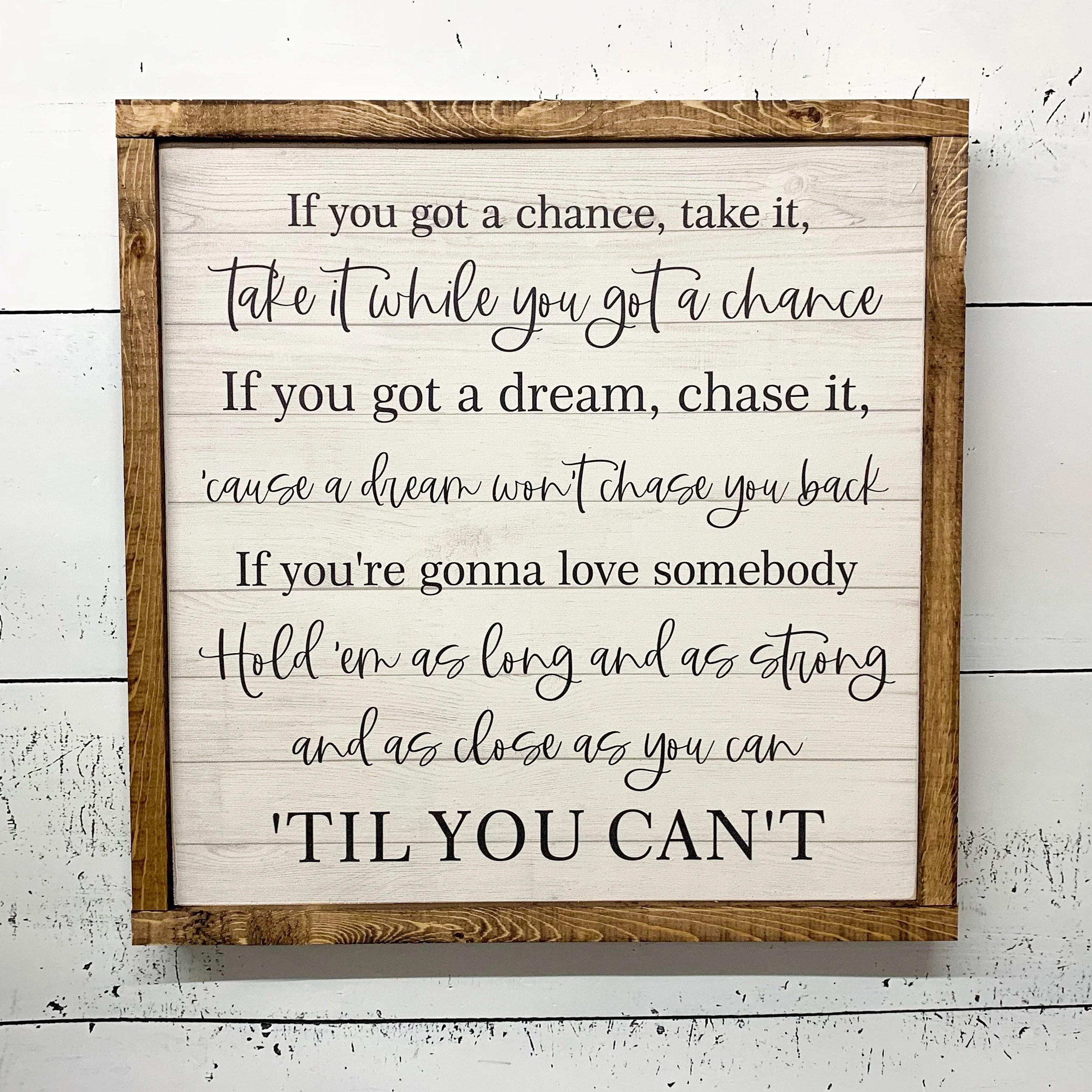
If you got a chance, take it, take it while you got a chance
If you got a dream, chase it, ‘cause a dream won’t chase you back
If you’re gonna love somebody
Hold ‘em as long and as strong and as close as you can
‘Til you can’t
There’s a box of greasy parts sitting in the trunk of that ‘65
Still waiting on you and your granddad to bring it back to life
You can always get around to fixing up that Pontiac
‘Til you can’t
If you got a chance, take it, take it while you got a chance
If you got a dream, chase it, ‘cause a dream won’t chase you back
If you’re gonna love somebody
Hold ‘em as long and as strong and as close as you can
‘Til you can’t
So take that phone call from your momma and just talk away
‘Cause you’ll never know how bad you wanna ‘til you can’t someday
Don’t wait on tomorrow ‘cause tomorrow may not show
Say your sorries, your I-love-yous, ‘cause man you never know
If you got a chance, take it, take it while you got a chance
If you got a dream, chase it, ‘cause a dream won’tchase you back
If you’re gonna love somebody
Hold ‘em as long and as strong and as close as you can
‘Til you can’t”
Bottomline: The words contained in the song ARE this week’s TRIPLE III TIME message. Whether the “Til You Can’t” motivation is driven by special friendships, co-workers past, child birth, graduations, weddings, job changes, retirements and/or unfortunately a death…reread this blog and:
“If you got a chance, take it, take it while you got a chance
If you got a dream, chase it, ‘cause a dream won’tchase you back
If you’re gonna love somebody
Hold ‘em as long and as strong and as close as you can
‘Til you can’t”
Public Sector Entrepreneurship Part III

It has been quite some time since I have authored an American Society for Public Administration (ASPA) article on one of my favorite topic areas: Public Sector Entrepreneurship! Part III of this continuous series again is intended to offer a few innovative options for incorporating entrepreneurship thought/practices into the public sector worlds-of-work.
Public Sector Entrepreneurship: PART III – PA TIMES Online | PA TIMES Online
TRIPLE III TIME: Generational Diversity & Public Responsibility
This week’s TRIPLE III TIME message is my quarterly guest author article for the American Society for Public Administration (ASPA) organization. For a group of consultant-focus reasons I chose to share my thoughts about a combined view of Generational Diversity & Public Responsibility.
Specifically, the article reviews the positions our different generations have taken with regard to assuming quality public responsibility. No, it is not designed to be an in-depth scientific study. Rather the article attempts to equally assess the U.S. citizens stance on priority public responsibility issues during the special generational sectors.
I hope you enjoy the article.
Generational Diversity & Public Responsibility
In recent times so much has been written and discussed about the differences between the specific generational sectors. Baby Boomers…Generation X…Generation Y (Millennials) and now Generation Z. Standard comparison topics have included: work characteristics, creativity, leadership, communication styles, organizational loyalty and work\life balancing. As you can guess the comparisons seem to report a high level of “changing-with-the-times” and a greater sense of independent thinking. However, if one takes a long look at generational concerns regarding consistent public responsibility for sustaining good government… traditional expectations and standards appear to remain.
An appropriate first example of discussion with regard to comparing generational diversity and related public responsibilities is the world of work. If one reviews the historic role of government in ensuring jobs for all from 1946-2012 (and beyond) …it would appear that consistency has prevailed. When one considers times of war, recession, private sector change challenges and/or global economy impacts, every generation has expected some form of governmental support action. Whether the action was a bail-out of the automobile companies or the restarts required following an international pandemic, the majority of every generation considered it a public responsibility for government to step-up and enact some form of progressive program/process to move the country forward. Understandably the citizenry from every sector voiced a wide variety of government options to improve the identified problems, however majority support was embraced for qualified public responsibility action.
Communication is another very notable generational diversity topic. Without question the way and means of sharing information with regard to public/governmental responsibilities on every communication level has undergone an immense assembly of changes. Every generation has had to make tremendous adjustments to socially and technologically adapt to ever-evolving communication formats. From regular phones to cell phones, regular television to streaming programs, in-person meetings to virtual webcasts… all generations have been charged to effectively make the necessary adaptions!
So have different generations loved and hated the communication changes…YES! Have those responsible for completing public responsibilities to their best ability regardless of the communication requirements done so…YES! Today extensive governmental activity communication is at an all time high. Truly advanced communication methodologies have made U.S. citizens the most informed in the world. But similar to the world-of-work, the public has the right to use communication alternatives with different priorities in mind. Therefore the result is often viewed in generational diversity terms, rather than just simple personality differences. Think about it.
Innovation, creativity and entrepreneurship are other recognized generational diversity areas of significance. If one studies the great discoveries, scientific improvements and/or inventions that have occurred during every separate timeframe, it is impossible to somehow generationally rank the multitudes of achievement. Also, it is difficult to assess how every innovation has provided new and better ways of accomplishment in the public responsibility arena. However, unquestionably both the private and public sectors have experienced some form of public responsibility gains as a result. The examples of creativity over the years are many including health care, transportation, nutrition, manufacturing, education, communication improvements and yes the list goes on. Regardless every generation has and continues to seek new alternatives to make way for a better public good. The only generational diversity comes in the form of prioritization and means of accomplishment. Hence, the intent I believe remains consistent with regard to satisfying public responsibility expectations and demands.
 A final but very important Generational Diversity & Public Responsibility topic that deserves analysis is our country’s two-party system. Throughout our history the diversity that exists between Democrats and Republicans has caused a great deal of leadership challenges, fluctuations in public responsibility commitments and variations in what policy areas deserve the greatest level of priority. However, regardless of the political situation that evolves or impacts of a citizen’s generational assignment… party selection does not appear to change their public responsibility perceptions.
Isn’t it substantial that regardless of a citizen’s age or their right or left wing party beliefs, their public responsibility policy followings have remained the same. This occurrence is documented based on our selection of presidents and policymakers over the years. As a result, the public responsibility values retained by Baby Boomers, Generation Xers, Generation Y-millennials and Generation Z individuals have shown that our country remains operating with a historical balance. Understandably this balance to addressing U.S. public responsibility has realized many strained times when “choosing political sides” is a driving force. However, somehow the dedication to providing the best public responsibility services comes to pass.
OK now it is logical to ask: Why is this article on Generational Diversity & Public Responsibility important? I believe in our current times it is critical to recognize and appreciate all of the public responsibility activities/elements that make the United States “governmentally shine”! Historically citizens have always had the opportunity to choose leaders and processes that make the nation progressive. Therefore, when looking at each generation… their differences and uniqueness, it is equally important to take note of a continuance of their positive pursuit of public responsibility. This genuine and authentic care for the betterment of our country is what our Founding Fathers considered most important.
 Inspiring Innovations, Inc.