Category Archives: LEADERSHIP – ALWAYS!
TRIPLE III TIME: Customer Service Made Easy!
I don’t know if I ever stated (or admitted) this fact in any of my blogs or podcasts…but yes I played trumpet in my family’s polka band. And I have to say that although we were not the greatest polka band in the world…we were pretty good! My Dad played accordion…my oldest sister the clarinet…older brother the drums and me on the trumpet. The bottom line truth is that none of us were superb musicians (except my Dad)…but we were great entertainers.
 Recently I had the privilege of enjoying an old-time polka band playing in a small local venue. The music was wonderful and the band members although senior in their years…were very much crowd pleasers in every way. So now you are asking when and why did this TRIPLE III TIME Customer Service Made Easy message idea become prime time in my mind while basking in this great musical moment?!
Let me explain.
During our polka band time…we were a SOLID TEAM. Our COMBINED TALENTS and SKILLS created a helpful, meaningful product/service. Our PRESENTATION STYLE and DELIVERY was always authentic and consistent. And finally our ability to be FLEXIBLE and ADAPTABLE to the needs and wishes of all attending our events…resulted in Customer Service Made Easy!
It would be fun to share more about our polka band experience which all faded way too soon. But this week it was an extreme pleasure to describe how being a SOLID TEAM with COMBINED TALENTS and SKILLS…and a quality PRESENTATION STYLE and DELIVERY while remaining FLEXIBLE and ADAPTABLE can not only be fun…but also be a working example of Customer Service Made Easy!
TRIPLE III TIME: Think Regionally (+)
One of the key factors when considering serious organizational development and/or business growth is to continually Think Regionally (+). Too many times those in leadership positions believe that there is some form of geographic or technological boundary that encompasses the area that they want/need to serve. This belief then gets passed on to all involved in planning strategies for the future. As a result whether it can be scientifically proven or not…limits of conformation are directly or indirectly incapacitating the size and scope of all forms of non-traditional development/growth potential.
So what is a progressive “fix”?
First, I would use specialized labeling to endorse a “wide-open” operational design to highlight any new concept. For example in the past I have used: IDEAS UNLIMITED CLUB, What Else Mapping, The IDEA Mill, and What Next? Newsletter as descriptors of initiatives that have no geographic nor innovation limits!
Next it is always valuable to invite individuals or organizations or businesses from outside your traditional zone of operation to consider futurisms with you. Historically it is easier and faster to limit those participating in planning activities. However, each time you make the choice/decision to limit creative input…YOU have thereby lessened your groups potential for creative output.
Finally, I can not think of a negative outcome when I/we considered and built a new product or service that included help from beyond our region, state and even nation. Involving these unique, non-affiliated participants into your organizational development/business growth planning sessions widens your customer understanding, service demands, potential partnerships and brand new opportunities everytime…EVERYTIME!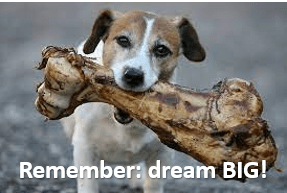
Think Regionally (+) simply asks…always dream beyond what’s normally possible! Oh yeah the plus sign (+) means don’t be afraid of exceeding expectations!
TRIPLE III TIME: The Role of “Professional Development Influencers”
Recently I received a unique consultant-based information-piece requesting that I apply to become a “Civic Influencer”?! First I have to admit that I had never heard these terms connected before…nor have I found myself in a professional situation that involved the discussion of this type of activity, So as I briefly researched the group that was recruiting applicants to become Civic Influencers… I began to better understand their purpose, processes and goals. And yes as you can guess I almost instantly thought about “Influencers” as the next high-quality TRIPLE III TIME topic!
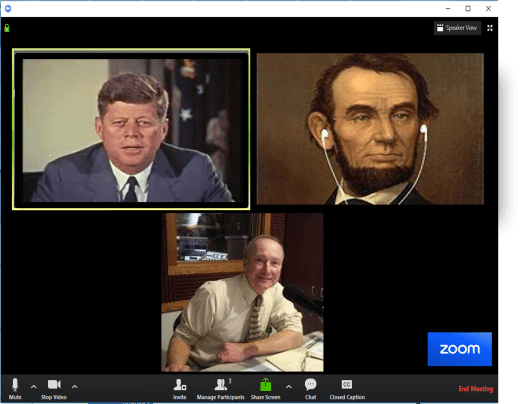
This week consider The Role of Professional Development Influencers in your world-of-work and the occupational network you maintain. Do they support being organized… participation in continuous learning… and advocate/promote causes that represent you and what YOU stand for? As you think about answers to these issues, check out this TOP 10 Influencer personal priorities as helpful guidelines.
GREAT Professional Development Influencers should:
- Speak when they know…not because they think they know the answer.
- Allow for and encourage questions regarding their own positions on issues.
- Encourage all forms of continuous learning/educational pursuits.
- Dress “like-they-mean-it” because it matters.
- Recognize with praise…better problem solutions and explain that a perfect solution never exists.
- Not discredit or speak badly of other Influencers.
- Try to offer authentic and special influences…not just regular “off-the-shelf” options.
- Support the strengths someone has…not an effort to try and be “everything-to everyone”.
- Suggest positive influences in progressive pieces…not too much too often.
- Be consistent in their commitments to being professionally organized, a continuous learner and true to the principles they promote.
Are YOU a GREAT Professional Development Influencer? Do you surround yourself with high-quality Professional Development Influencers? Maybe taking stock of and assessing YOUR Influencer impacts is an important NOW/TODAY exercise!
TRIPLE III TIME: The Challenges of Starting Over
 In everyone’s workplace world…leaders, co-workers, colleagues and just job-related friends come and go throughout the years. The circumstances for their job or career change can vary from family concerns…to physically moving to a new area…or a different job that maybe has a huge salary increase! But no matter the change…The Challenge of Starting Over is often a confusing, time-demanding and difficult transition for many.
In my experiences, The Challenge of Starting Over with new leadership personnel has often delayed or negatively impacted the establishment of mutual priorities for organizational development, need to maintain a high level of momentum with regard to actions/events/projects currently in play and the creation of a new/altered method of quality/timely communication. As you can see all three of these actions do not progressively improve over-night and not without the appropriate amount of professional nurturing. Therefore, it is necessary to step-back and as a leader take a high-level assessment of the entire Starting Over situation and adopt a co-equal methodology for moving forward together!
Simple, straight-forward actions may include:
- Automatically sharing operational messages to help understanding of product/service plans.
- Take the initiative to invite the new leader to moving forward style meetings.\
- If not co-located…visit them at their office/place-of-major-business.
- Make phone calls and in-person visits your primary method of communication at first.
- Offer a list of YOUR principle network of leaders for them to be aware of.
- Be sure to promote INCLUSION as a priority to your current-co-workers to set an example of “openness” for information.
The Challenge of Starting Over will only be harder and become more difficult if you ignore it.
TRIPLE III TIME: Wants-Versus-Needs-Versus-Recommendations
Today as I work with multiple customers in a variety of professional sectors, the decision-making patterns between what is wanted by customers…versus what is more needed…versus the recommendations I offer…seems to be more irregular and confused than in times past.
What do I mean?
With all of the ever-expanding training/learning topics available…combined with the diverse options for training/learning program delivery, deciding what is wanted or needed for maximum personal/organizational/business effectiveness and efficiency has become ultra-challenging. And then when one asks a “once-removed” consultant for their input…the uncertainty only grows.
So what’s a workable answer?
This week’s TRIPLE III TIME: Wants-Versus-Needs-Versus-Recommendations message goal is to encourage everyone to go back to the beginning…to better find the best customer service answer. Too many times individuals or groups seeking professional advice are not FIRST asked the toughest help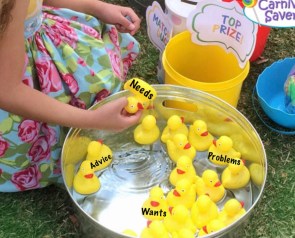 question: What problem are you really trying to solve? If you can get everyone involved to initially focus more directly on solving the core customer service problem…the more likely you are to best identify the need(s) to be addressed!
Customers seeking your product or service always have many wants and needs. The easy customer satisfaction route is to just provide them with their “want” and move on! The tougher but more progressive route is to help address their specific problem areas and thereby concentrate on their real developmental needs.
Focusing exclusively on customer problem/need areas may regularly cause “professional discomfort” in performing your “day-job”! But if you are committed to really helping people…that is your biggest responsibility.
LEADERSHIP: Always a Custom Blend
If you ever think that a term like Leadership has been completely defined or is not in need of continuous improvement… you would be wrong! A great explanation of this issue is included in a summary of a TED Talk offered by Shelley Prevost a few years ago entitled: “Lead Like A Girl”.
“As leaders, we can find ourselves feeling like we have to cut off the other parts of ourselves in order to focus solely on the part that makes us a leader. So we don’t talk about our children or our partners, we forget how we act around them, and we assume that this is a different part of our personality. However, Prevost believes that it’s these seeming paradoxes that make us great leaders-we don’t just have to be a leader; we can be a nurturing leader. Or a funny leader. Or a thoughtful leader. We can create our own definitions.”
 It has taken me quite some time to get past an early-career leadership practice when I standardly felt the need to “put on my Director’s face” in order to correctly deal with a challenging issue. For much of my career I believed that I had to totally change my “regular” leadership personality/style to effectively address ever-changing situations. However if you follow Shelley Prevost’s great leader beliefs…being ultra-direct, nurturing, thoughtful, funny and many other traits are all human elements that contribute to make us “Leadership-Whole”. And doesn’t that just follow being authentic?
Bottomline: Today, think about checking YOUR own definition of leadership. Does it match up with who you are and what you stand for? Or are you trying to fit into someone else’s definition of leadership and thereby losing your sense of authenticity, trust and believability?
TRIPLE III TIME: “He or She Ain’t the Boss of Me!”
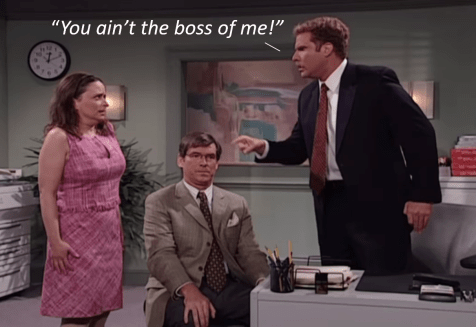
I am guessing and hoping that everyone is giggling or even laughing out loud as they read this week’s TRIPLE III TIME message title: “He or She Ain’t The Boss of ME!” And as I have thought about this topic, I am believing that most…if not all of us have heard this exclamation a time or two. Maybe it was said in jest…or maybe in an angry frustrated moment. However, I would bet that few have taken the time to assess the personnel influences standing behind this negative proclamation?!
So this week I want to take a serious TOP 10 look at the “behind-the-scenes” personnel influences that drives the: “He or She Ain’t The Boss of ME!” statement.
- Does this statement come out due to confusion on who answers to who?
- Are there one or two individuals that incorrectly assume they are managers or directors?
- Do your operations directives have oversite gaps?
- How current is your organizational flow chart?
- Is your agency/business driven by a team of micro-managers?
- Can innovative thoughts and actions be assumed in your place of business?
- Do your employees worry more about what certain people think or a quality product/service?
- Does organizational history of leadership overshadow what is actual today?
- Are job titles, earnings and/or tenure allowed to over-impact REAL Boss of Me issues?
- Does everyone have an opportunity to lead or follow based on assumptions or expertise?
These are all serious questions regarding the “He or She Ain’t The Boss of ME!” concern. Consider them one at a time to discover any Boss of Me issues that need to be addressed.
TRIPLE III TIME: “Partnershipping”

First let me just say this out front…: NO I don’t think Partnershipping is a real word! But for today I don’t think those responsible for dictionaries will care.
Second, I believe that too often today individuals, organizations and/or businesses do NOT embrace Partnershipping as a first priority when building a new initiative. And when I refer to Partnershipping I don’t just mean groups getting together…I am referring to simple, individual, person-to-person partnership actions too!
As I work with different organizations or individuals on planning for the future, I standardly ask them about their current and anticipated Partnershipping strategies. The unfortunate response is: “Well we are thinking about that…but it’s way down on our list of priorities.” And the rationales that follow include:
- It would take too long to get everyone on the same page.
- They probably wouldn’t be interested.
- It is mostly our responsibility.
- There isn’t enough money to make it worth their while.
Are these the rationales of a Partnershipping Drop-Out?
I realize I am framing the task of effective Partnershipping in a light-hearted way…but please know that it is a high-value professional development asset. Most of my best leadership and innovation achievements were (and still are) the result of old and new Partnershipping!
Bottomline: Make Partnershipping one of the first considerations when starting or restarting an initiative. Great minds can and do think alike.
TRIPLE III TIME: The Art of Hiring The Right People
 One of the most challenging responsibilities for leaders of any business or organization is hiring the right people. During times of economic progress the recruitment and selection of new employees becomes even more difficult due to the limited number of available hires. And even when the pool of employment candidates is higher, the challenge of selecting the best person gets clouded based on qualifications, the results of every interview and thoughts about “fit” in your group(s).
Perfection again is not possible in The Art of Hiring The Right People. However British-born American author and inspirational speaker Simon Sinek offers some great advice with the following quote:
“If you hire people just because they can do a job, they’ll work for your money. But if you hire people who believe what you believe, they’ll work for you with blood and sweat and tears.”
In my organizational leadership days, I was lucky enough to follow the hiring strategy outlined in Mr. Sinek’s words and surround myself with the right people. Did money sometimes become an issue…yes…but most times the greater challenge was to find the right place for individuals who “fit” our agency…but were not in the best employment position where they could make their maximum contributions to the “cause”.
The most important take-away from this week’s TRIPLE III TIME… The Art of Hiring The Right People message, is to prioritize the personnel-values contained in Simon Sinek’s quote. Regardless of your business or organizations service or product, you as the leader/owner know the beliefs, blood, sweat and tears that make your entity “the best in the business”! Therefore, never minimize these factors when hiring.
TRIPLE III TIME: A Strategy Behind The Strategy
It was mid-term exam time for my American Government & Politics classes this past week and for the most part all of the students did fine. And as I passed the corrected tests back and gauged the reactions…one young man pointed his finger at me and stated: “Now sir I know why you make us do those one page Position Papers each week…to get us practiced to answer these essay questions in the same manner…right?”
Well I did NOT deny the accuracy of this discovery and I completely agreed and said: “Yes I do practice having A Strategy Behind The Strategy for helping all of you get totally ready to get an A on these exams!” And you can guess he was very proud of his revelation and was rewarded with smiles and multiple nods of support from his classmates! I too joined in the smiles…but mine came more from a remembrance of my Dad and his use of A Strategy Behind The Strategy for getting me ready for my tomorrows.
What do I mean?
Think about it…as a very young boy he put me “in charge” of all of our baby calves. I didn’t think it was right…but when he later said he didn’t think I was old enough to drive a tractor yet…I reminded him how much I could do when I was “way young”…and so I was very ready to do tractor-driving jobs…and MORE WORK!
Do you think Dad had A Strategy Behind The Strategy?
And if you don’t think I picked up on Dad’s strategies…I have to tell you I was caught many times by a co-worker or two. Like when we cross-trained everyone in organizational services and even sent “office-people” out in the field to help client-customers face-to-face. Or when we tried to better communicate in a more complete way about Agency activities every week.
Do you think I had A Strategy Behind The Strategy for reducing “that’s not my job” attitudes or “I can’t do that stuff cause no one told me” claims?
Bottomline: Always think about having A Strategy Behind The Strategy as a means of creating personnel and organizational growth. It helps you and those around you consider “What Next?/What Else? possibilities.
 Inspiring Innovations, Inc.