Category Archives: DEVELOPING YOU!
TRIPLE III TIME: What’s Your “Value Package”?

Whether you are (or work for) a private company or public organization…every so often I believe it is not just important but absolutely critical to ask: What’s Your “Value Package”? Does everyone understand what this question refers to?
Well before I get into the factors that I consider true company/organization Value Package components…it is important for me to report that this TRIPLE III TIME topic was generated via a local grant application! How excellent I thought it was for a grantor to ask every applicant to identify and describe what makes them special…RIGHT? Yes, often applicants do well to include cool, confident…special attributes about themselves…but this was the first time I officially saw it in writing as a requirement of the grant application!!
OK…enough background…now let’s focus on TRIPLE III TIME What’s Your “Value Package”? factors. So here is my initial list but be advised that these factors are not in any particular order.
- Simplicity: With the huge rise in everyday information-sharing…keeping things simple has high value.
- Convenience: Making it a priority to make doing business with you easy and convenient will draw in great customers.
- Reputation: Having a REAL high quality reputation is only generated if you do great work.
- Timeliness: Being recognized as a business that delivers products/services on-time is a solid value attribute.
- Reliability: If you make a promise…keep it in the world of business.
- Accessibility: In today’s 24/7 communication world, remaining readily accessible to customers can be a priceless value.
- Innovation: Retaining a practice of offering creative/innovative solutions to business/organization challenges has unlimited value to many.
As you can see every factor that I have listed in this draft “Value Package”…would very much contribute to labeling your group as SPECIAL!
So please take some TRIPLE III TIME and solidly respond to the What’s Your “Value Package”? question.
TRIPLE III TIME: “Crowd-Driven-IDEATION”

Did or do you work in an organization that always looks to a single employee as the “regular idea person”? You know what I am referring to. The situation that traditionally expects a certain person to be the standard source for new ideas/concepts/innovations?!
Is this a good practice? Does this occurrence mean that only “chosen” people are able to come up with cool new ideas…and everyone else gets a “pass” on thinking innovatively?? Does this practice also mean that if only one or two people in an organization think about the value of creativity in the workplace…and they leave…that the group would be instantly falling behind the times??
Well, no matter how you respond to the initial TRIPLE III TIME message questions…today I believe we need to more frequently embrace a “Crowd-Driven-IDEATION” methodology! Specifically, this means that the more people one involves in the building and facilitation of a new product or service idea…the greater potential it may have for quicker/more complete success.
OK…this process sounds easy but for today, I want to initiate a thought process of factors to consider if one adopts a “Crowd-Driven-IDEATION” path.
- Would you feel comfortable asking others to co-ideate?
- Could you deal with a reduced level of control over the idea?
- Would you be willing to allow co-ownership of the idea results/profit/loss?
- Would “Crowd-Driven” mean greater involvement of technology in the entire idea-building process…and would that be ok?
- Would “Crowd-Driven-IDEATION” offer the potential for more fiscal support for the idea?
- Could “Crowd-Driven-IDEATION” cause total cancelation of the initiative?
- Would a shared idea-building option improve/make selling the new concept more flexible?
- Is “Crowd-Driven-IDEATION” a better tool for maximizing an idea?
- Does “Crowd-Driven-IDEATION” creatively expand the geographic application/support of the idea?
- And finally a critical consultant question I have asked many times: How can an idea be considered good or great…unless shared with others?
These unique TOP 10 “Crowd-Driven-IDEATION” consideration questions are all important when partnering on real innovation and creativity concepts. Give each one adequate thought…then GET GOING!
TRIPLE III TIME: Special “Best Of!” Assignment

In many situations during my consultant discussions, individuals or groups are best helped when I can offer them an experience, visual and/or a specific person as a “Best Of!” example of the professional development issue I am trying to push. Too often we get lost in the details of the basic progressive point we are trying to explain…and then walk away questioning if we really helped someone “get” the message principles/priorities?!
Well this week the TRIPLE III TIME message is asking everyone to complete a Special “Best Of!” Assignment and determine who or what have been your GREATESTprofessional development messengers. Think about it.
- Who and why does a certain person(s) serve as YOUR professional development “Best Of!”?
- What and why does a specific visual(s) help you think/move forward?
- How and why does a past experience(s) give you motivation for doing more than the minimum?
- When and why have you been inspired to share a special learning moment that felt “once in a lifetime” like?
And as you think about each question…maybe make a list of “Best Of!” reasons.
The goal of the Special “Best Of!” Assignment is to remind you of the critical points that today (and maybe even more tomorrow) make you better in the workplace and in regular life. Your “Best Of!” lists should contain personal lessons and professional development factors that in many ways are timeless.
Make sure you enjoy this Assignment!
TRIPLE III TIME: Don’t Minimize Mental Health First Aid
“We’re all used to looking after our physical health, but we need to be just as vigilant when it comes to our mental health. Emotional first aid builds our empathy muscle and supports those around us.”
(Harriet Minter & Guy Winch: Prioritize Mental Health-Great TED Talks)
 I have to start out this TRIPLE III TIME message with an admission that I did not really give the necessary amount of attention to the mental health needs of people I worked/networked with until recent years. Maybe I was lucky and dealt with it appropriately in my early career…. but I did not recognize it’s significant impact in the workplace until it became a more open discussion item.
Probably the biggest eye-opening moments regarding mental health concerns have come during my college teaching times. I can not even guess the number of “Position Paper” assignments I received that in some way discussed the growing need for mental health help among our young adults.
The Papers were written in a more sincere fashion and often with real life examples of the challenging effects of mental health-based illnesses. The result for me was to first become more knowledgeable about the topic… but then as a consultant attain the capacity to discuss mental health impacts with all organizational levels.
I am not an expert but TIME-ATTENTION-CONNECTIONS are my three TRIPLE III TIME words of support so you: Don’t Minimize Mental Health First Aid.
- First as a oversight leader offer appropriate TIME in your workplaces to recognize and treat mental health issues.
- Then be a facilitation leader by creating the most appropriate health care ATTENTION for suffering individual(s).
- Finally, be a multi-purposed leader and obtain all of the professional mental health service CONNECTIONS which may be able to offer assistance.
Success for everyone’s future will require Mental health First Aid prioritization. Do it well and the return-on-investments will be genuine!
TRIPLE III TIME: A Personalized SUPPLY CHAIN?
I don’t care how old you are…your current employment situation…where you live…how much education you have…and/or your financial status…I will bet you have never constructed A Personalized SUPPLY CHAIN visual projecting your “what-next”…future life/work steps?
Think about it! Consider the special value of creating a private business-based, step-ladder designed…one-page diagram of YOUR plans for the future.
Over the years as I have worked in my director/consultant day-jobs, I have used a SUPPLY CHAIN structure many times to make a basic plan for steady Creation & Development for multiple people and organizations. The use of a short…to-the-point SUPPLY CHAIN visual…in almost every situation allows for quick, direct focus by EVERYONE…EVERYTIME!

Go ahead…put YOUR name at the top of the Creation & Development… A Personalized SUPPLY CHAIN chart! So now what?
First, I can reassuringly report to everyone that thinking about the “What Do I Want?” section always seems to be the toughest part of building the SUPPLY CHAIN. Trying to narrow down and make simple this first area is naturally a “where do I start or restart” challenge! However, once people get past “Pre-Planning The Want”…not surprisingly many of the next development areas seem to come more easily.
Next it is necessary to keep an open…yes innovative-mind as you consider any and all personal growth factors. Remember today there are so many more informational items/opportunities online (even across the globe) that can enhance A Personalized SUPPLY CHAIN. So to achieve the bottom-line goal…a single page document/outline that “charts-YOUR-course” for quality personal and professional development…can prove to be a wonderful action endeavor.
I hope you create a cool SUPPLY CHAIN. I also hope you don’t make it too detailed and overwhelming right from the start. Baby steps are AOK…as long as they are future steps.
Enjoy this special assignment.
TRIPLE III TIME: What Do Customers REALLY Want?
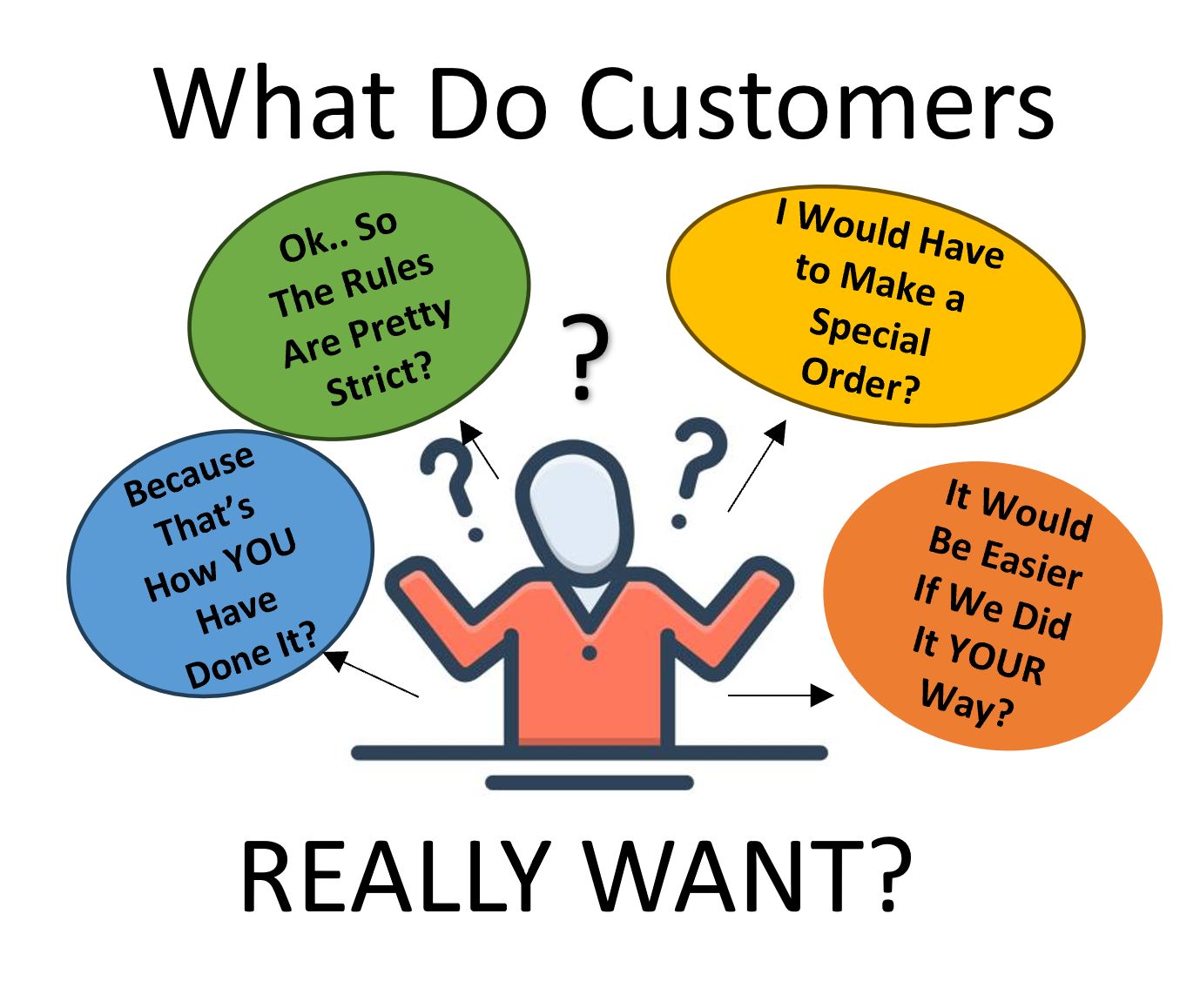
It is always interesting to work with different public and private organizations and talk with them about their customers…their wants…needs…service/product expectations and adjustments that may need to be made. One of the most challenging discussion areas is how different groups determine: What Do Customers REALLY Want?
In a way this question and the answer(s) should come about very easily…right?
Well as YOU work with customers in YOUR day job…do YOU do a solid job answering this TRIPLE III TIME question?
What I have found is that many times history provides the first-line answer to the customer Wants question. Or sometimes it is the governmental guidelines that take precedence over questions asked. Or pre-determined answers that are driven by… “this is all we have right now”?! Or finally there is the likely occasion that customer Wants are organized around a strategy of services via “staff convenience”?!
In ALL workplace situations today…I think it is prime time to relook at the ever-critical question: What Do Customers REALLY Want? In my consultant business I have to report that rarely do potential customers REALLY know exactly what they Want the first time we sit down. Instead it is only after a more detailed question, answer and discussion period that the best REALLY Want answer shows up.
Times have changed…people have changed…products and services in all areas have changed…so the: What Do Customers REALLY Want? question answer(s) should not be easy or automatic. Rather allow customers and yourself the progressive discovery time to develop the best Want answer possible. Time and money are both factors that seem to become more limited each day. Therefore, taking some quality time to get the better/best: What Do Customers REALLY Want? answers early on…will be a priceless return-on-investment in the long run.
TRIPLE III TIME: TRANSFORMATION is NEVER a Single Event
“Transformation is a difficult process for workers at all levels of the organization. Employees who have spent decades responding to orders are now being asked to think, innovate, and make strategic decisions. Workers accustomed to being commanded from above must now assume a high level of autonomy and responsibility.
While many companies will make the transformation to the new story of business, others are likely to remain stuck in the old story. Some will simply refuse to acknowledge the need for transformation. Others will confuse transformation with reform, and attempt to apply new story approaches within fundamentally unchanged organizations. Still others will begin the transformation, only to revert to the old story during a period of crisis.”
(Quotes taken from Charles Garfield’s book: Second To None…The Productive Power of Putting People First.)
It is so important to take some TRIPLE III TIME…and critically absorb all of the very important points contained in Mr. Garfield’s words. Purely his reminding all of us in any workplace…that TRANSFORMATION is NEVER A Single Event!
Think about all the variables that will impact our worlds of work today and tomorrow. New bosses, employee changes, different products, diverse customers, more (or less) organizational operations dollars, a global economy, governments & politics and the list continues. So when someone tells you to take TRANSFORMATION personally…they are offering very solid, timely advice.
Continuous organization/business TRANSFORMATION is now just a necessary “standard operating procedure” in order to stay strong and competitive in today’s economy. Likewise, as Mr. Garfield points out, critical thinking, employing innovation options and making strategic decisions has also become a regular equal opportunity responsibility for personnel at all operational levels.
Is TRANSFORMATION a bad thing…absolutely not!! Accepting that TRANSFORMATION is NEVER A Single Event and that adopting an operational philosophy that progressive change is and should be an everyday opportunity…is just growing in the right direction!
TRIPLE III TIME: The LIMITS of Having a Routine

Isn’t it interesting how many people have and even depend on having a routine for their daily functions! Now don’t start thinking that I am making fun of these very important… staying life-organized… stability-driven… and monitoring yourself (and maybe those who you live and work with) responsibilities. However, have you ever openly considered The LIMITS of Having a Routine with regard to not allowing CREATIVITY… IDEA GENERATION and INNOVATION in your everydays??
I believe that there are a whole group of people in the world that think: “I wish I could have … would have… should have…” when considering The LIMITS of Having a Routine existence. People have sacrificed pursuing a unique career, attaining some form of higher education opportunity and/or visiting out-of-the-way places… in lieu of employing a life/work routine that promotes standardized consistency.
Well as you have probably already guessed… the REAL purpose of this TRIPLE III TIME message is to offer unique concepts on how to “bend” The LIMITS of Having a Routine and maybe adopt a few “cool variations” into your routine! Possibly you start by:
- Establishing a CREATIVITY TIME GAP every day. (Maybe begin with 15 minutes… then 30…60?)
- Establishing a WHAT ELSE? LIST of activities that are mentally/physically non-traditional in your days.
- Establishing a NON-AGE CONNECTED MENU of thoughts and social media information items to review and study each day.
- Establishing an ADVANCING PERSONAL GROWTH LADDER. Each week consider a club, class, volunteer service group, etc. to join and grow with.
- Establishing a brand-new OPPORTUNITY NETWORK for yourself. Its purpose and membership can be all yours.
Truthfully, I appreciate a routine too. But I also appreciate the Super 5 ROUTINE UNLIMITERS outlined above to help me take personal and professional growth steps… everyday… EVERYDAY!
TRIPLE III TIME: Costs of Poor Customer Service
There have been many articles and maybe even books written about the Costs of Poor Customer Service. And whether it is exactly true or not… “estimates of the cost of poor customer service range from $75 billion to $1.6 trillion per year” (midlandstech.edu)! Unfortunately as I talk with individuals who are on an entrepreneurship path toward building a successful new private business or public service, the economic value of attaining and retaining GREAT customer service is a huge factor in many of our discussions.
How is the incidence of poor customer service approached when I talk with business/agency leaders? Well I start with the almost common sense list of impacts:
- Direct loss of customers (new and old)
- Person-to-person poor reputation communication
- Confused strategic planning action
- Uncertainty in new marketing practices
- Lay-offs/firings and continuous staff turnover
- Over-orders…Under-orders
This is probably just a partial list of Costs of Poor Customer Service challenges that need/deserve attention for today’s world of work.
Then the questions about why customer service is poor get appropriate time…but again common sense understanding comes through:
- Employees aren’t listening to customers
- Cost-cutting has lowered customer service
- Organizational growing pains have caused customer service gaps
- Personal approaches have been over-reduced and technologically replaced
- And yes there are others!
Fortunately…just like this TRIPLE III TIME message our last segment of consulting moments addresses a number of “prime-time” suggestions on how to improve customer service.
- Become a “student of quality customer service in your workplace.” Observe, take notes, ask questions and share REGULARLY good actions.
- Conduct a REGULAR “what else?” survey with current customers.
- Allow innovation and creativity to your products and services with some REGULARITY.
- Do not allow one employee to over-power the “new idea book” on a REGULAR basis.
- Pursue a customer service approach that ensures some form of REGULAR live personal contact.
I hope everyone gleans some ideas from this TRIPLE III TIME message…and then excels REGULARLY in all forms of Customer Service!!
TRIPLE III TIME: Stress & Creativity: Opposites Attract!
“When you choose to view your stress response as helpful…you create the biology of courage. And when you choose to connect with others under stress…you create resilience.” – From Kelly McGonigal: “How To Make Stress Your Friend” 2013
Today everyone seems to be negatively impacted by stress. Whether it’s generated by family issues, job concerns and/or the challenges that arise from daily life events….stress is a component. Also it does not seem to be more age related or specific to a certain type of employment situation. Rather the common statement that is reported is: “Man…I am really stressed-out today!”
If you refer back to the statement by author and speaker Kelly McGonigal at the beginning of this TRIPLE III TIME message…you quickly realize that it is UP-TO-YOU on how to view and respond to stress.
Think real hard about this Stress & Creativity: Opposites Attract opportunity. When I think about my stresses and approaches on “How To Make Stress Your Friend”…a bunch of personal examples come to mind.
- Allow stress to be a performance motivator.
- Accept that stress is a natural occurrence and can/should be handled so personal and/or professional improvement is the goal.
- Engage stress as an opportunity to gain problem-solving skills.
- Consider sharing your stress feelings with others you trust to expand the course of regular friendships.
- Utilize stress to develop your ability to better focus during challenging times.
These are just a few examples of transitioning stressful times over to options and opportunities to make you stronger in many ways. Remember ultimately it is YOUR choice to negatively or CREATIVELY handle stress.
 Inspiring Innovations, Inc.